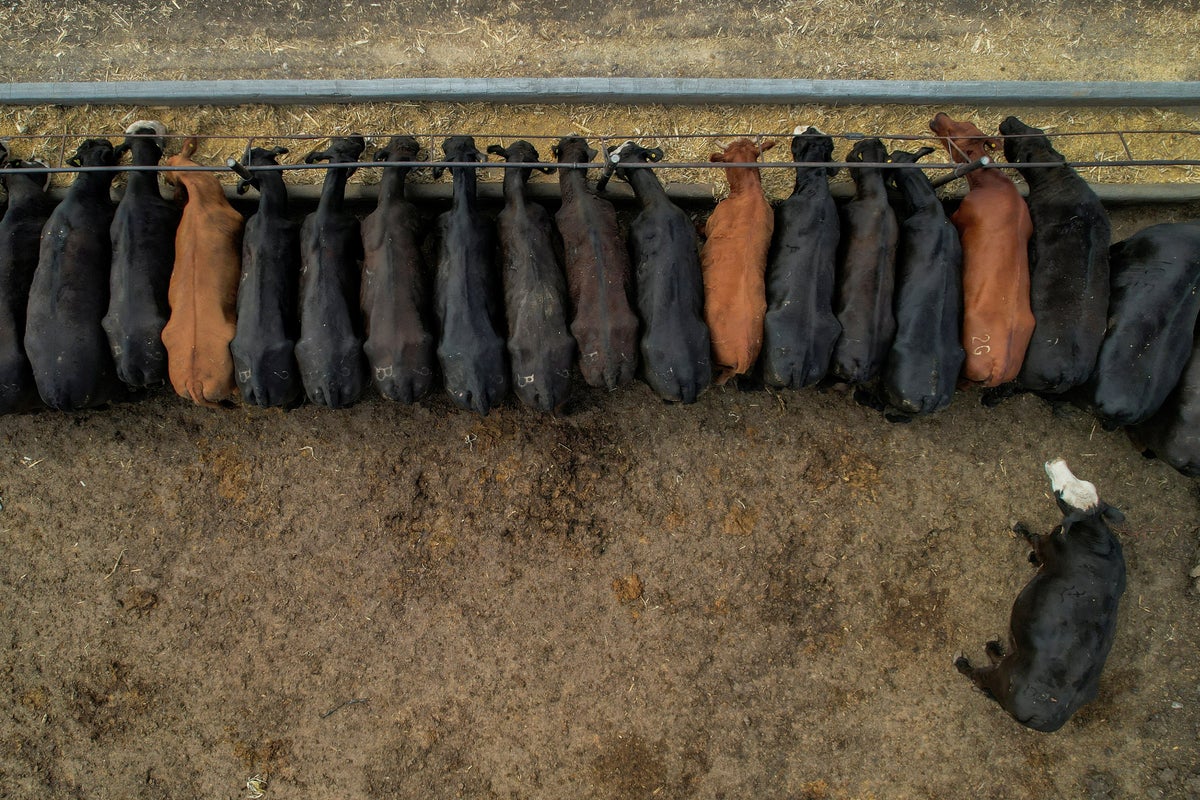
The detection of the New World screwworm (Cochliomyia hominivorax) in a three-week-old calf in Zavala County, Texas, exposes a critical vulnerability in continental biosecurity. This single larval infestation in La Pryor marks the first breach of the U.S. mainland by the flesh-eating parasite since 1966, outside of an isolated 2016 outbreak in the Florida Keys wildlife. The incident is not a random ecological anomaly; it is the logical consequence of a broken biological barrier that has collapsed sequentially through Panama, Costa Rica, Nicaragua, and Mexico over the past three years.
To evaluate the true threat to the $113 billion U.S. cattle industry, analysts must look past political rhetoric and alarmist headlines. The situation demands a rigorous look at the economic cost functions, reproductive mechanics, and containment bottlenecks that govern this parasitic threat.
The Microeconomic Shock Model
The economic threat of Cochliomyia hominivorax does not stem from food safety failures—the larvae do not infect processed meat, and the food supply remains secure. Instead, the economic impact is driven by a massive increase in operational costs for producers, coupled with severe restrictions on trade.
The U.S. Department of Agriculture (USDA) estimates that a widespread outbreak could inflict $1.8 billion in damages on the Texas economy alone. This economic shock can be broken down into three distinct financial pressures:
1. The Labor and Variable Cost Escalation
In a screwworm-free environment, cattle management relies on macro-level herd surveillance. The introduction of a parasite that targets open wounds forces ranchers to shift to an intensive, animal-by-animal monitoring protocol.
Female flies are attracted to wounds as minor as a tick bite, a branding mark, a dehorning site, or a newborn's navel. Consequently, producers face a steep rise in variable costs, including:
- Labor Hours: Mandatory daily inspections of every animal in an infested zone to detect early-stage larvae before deep tissue destruction occurs.
- Prophylactic Treatment: Widespread application of larvicides and topical treatments to any animal undergoing standard husbandry procedures (e.g., castration, shearing, ear-tagging).
- Direct Mortality: Capital losses from untreated infestations that progress to systemic secondary infections or death within 7 to 14 days.
2. Supply Chain Contraction and Inflationary Pressures
Texas holds $17 billion worth of the nation's cattle, making it the top livestock producer in the United States. A localized quarantine—such as the 20-kilometer (12-mile) zone established around the Zavala County index case—restricts the movement of all warm-blooded animals.
Scaling this quarantine model up chokes off the supply line of feeder cattle moving to midwestern feedlots. Because the broader U.S. cattle market is already experiencing record-high consumer beef prices due to cyclical herd liquidation, any major disruption in Texas livestock movement creates an immediate supply shock that drives retail prices even higher.
3. International Trade Penalties
The macro-level threat rests on the "regionalization" of trade restrictions. If foreign trading partners refuse to accept localized geographic containment zones, the discovery of screwworms can trigger blanket bans on live animal exports from the entire United States. This dynamic completely alters the net export value of the domestic livestock sector.
The Biological Multiplying Mechanism
Understanding the velocity of a potential screwworm epidemic requires analyzing the reproductive dynamics of the fly. The insect possesses a unique reproductive strategy that makes it highly efficient at expanding its geographic footprint.
[Gravid Female Fly]
       │
       ▼ (Deposits 200–300 eggs in open wound)
[Larval Stage / Maggots] ──► (Feeds on living tissue for 5–7 days)
       │
       ▼ (Drops to soil to pupate)
[Pupal Stage in Soil]    ──► (Emerges as adult fly in 7–14 days)
The biological acceleration is driven by three main factors:
- Obligate Parasitism: Unlike standard blowflies that consume necrotic tissue, Cochliomyia hominivorax larvae feed exclusively on living flesh and fluids. This creates a compounding wound that continuously attracts more gravid females to the same host.
- High Output Potential: A single female can deposit between 200 and 300 eggs per clutch, and up to 3,000 eggs across her 10- to 30-day lifespan.
- Vector Dispersal via Wildlife: While the adult fly has a limited independent flight range, its primary mechanism for long-range dispersal is passive transport. Wild animals, particularly white-tailed deer, act as uncontrolled, highly mobile biological hosts that carry larvae across fences, quarantine lines, and international borders.
Technical Constraints of the Sterile Insect Technique
The cornerstone of the USDA’s eradication playbook is the Sterile Insect Technique (SIT). This strategy relies on an absolute numbers game: flooding an infested ecosystem with millions of laboratory-reared, irradiated male flies. Because female flies mate only once in their lifetime, a successful copulation with a sterile male produces entirely unviable eggs, causing the local population to crash.
While theoretically sound and historically proven, the current implementation faces severe structural bottlenecks:
The Production Capability Deficit
For decades after the U.S. achieved eradication, the biological barrier was maintained exclusively at the Darién Gap in Panama. This geographic bottleneck required only a single production plant to supply the necessary volume of sterile flies. However, the multi-country collapse that began in Panama in 2023 and advanced through Mexico by late 2024 has completely overwhelmed that single-source supply chain.
The Logistics and Distribution Chokepoint
Deploying sterile flies requires highly coordinated cold-chain logistics. The pupae must be transported under strict temperature controls to delay emergence, then dispersed aerially or via ground release chambers before they die.
The current allocation of 4 million sterile flies per week to the south Texas containment zone represents a highly localized defensive posture. Scaling this intervention to cover a wider multi-state infestation would rapidly outstrip current production, even with the newly planned $750 million facility in Texas and the conversion of a fruit-fly plant in southern Mexico.
The Quarantine Playbook
Defeating the incursion requires moving past reactive monitoring and implementing an aggressive, data-driven defense. The immediate tactical focus must center on stabilizing the Zavala County containment zone and preventing the pest from establishing a self-sustaining population.
                  [Index Case Confirmed: Zavala County]
                                   │
                 ┌─────────────────┴─────────────────┐
                 ▼                                   ▼
   [20-km Strict Quarantine Zone]      [SIT Population Suppression]
   • Mandatory inspections             • 4M+ aerial sterile flies/week
   • Zero uninspected animal movement  • Localized ground chamber deployment
                 │                                   │
                 └─────────────────┬─────────────────┘
                                   ▼
                   [Peripheral Border Trapping]
                   • Genomic sequencing of captures
                   • Dynamic adjustment of barrier line
The frontline strategy requires three immediate operational changes:
1. Dynamic Boundary Testing
The current 12-mile quarantine zone cannot remain static. State and federal agencies must deploy a dense grid of traps baited with synthetic attractants along the periphery of the zone.
Every captured specimen must undergo immediate genomic sequencing to determine if it originated from the Mexican lineage or the local index cluster. This data provides an objective look at whether the fly has already breached the initial perimeter.
2. Mandatory Assembly-Point Inspections
Because the transport of an infected animal accelerates geographic spread faster than natural fly migration, inspection protocols must shift upstream.
Every livestock auction barn, shipping yard, and feedlot receiving cattle within a 100-mile radius of the border must implement verified veterinary clearance protocols before any animal can be loaded onto transport vehicles. Relying on visual checks by producers at the pasture level leaves too much room for error.
3. Systematic Wildlife Sampling
Because white-tailed deer populations cross cattle ranches without restriction, the USDA must partner with state wildlife agencies to conduct targeted sampling of hunter-harvested game and vehicular wildlife fatalities.
If the wild ungulate population shows a sustained larval load, the sterile fly release strategy must be recalibrated. Aerial drops would need to shift focus away from managed pastures and toward dense brush habitats where wild hosts congregate.
The outcome of this biosecurity challenge depends entirely on processing capacity and execution speed. If the current sterile fly supply chain cannot keep pace with the parasite's reproductive rate across its wild and domestic hosts, producers will face a fundamental structural shift: moving from a low-cost, pasture-rotation production model to an expensive, high-labor containment framework.