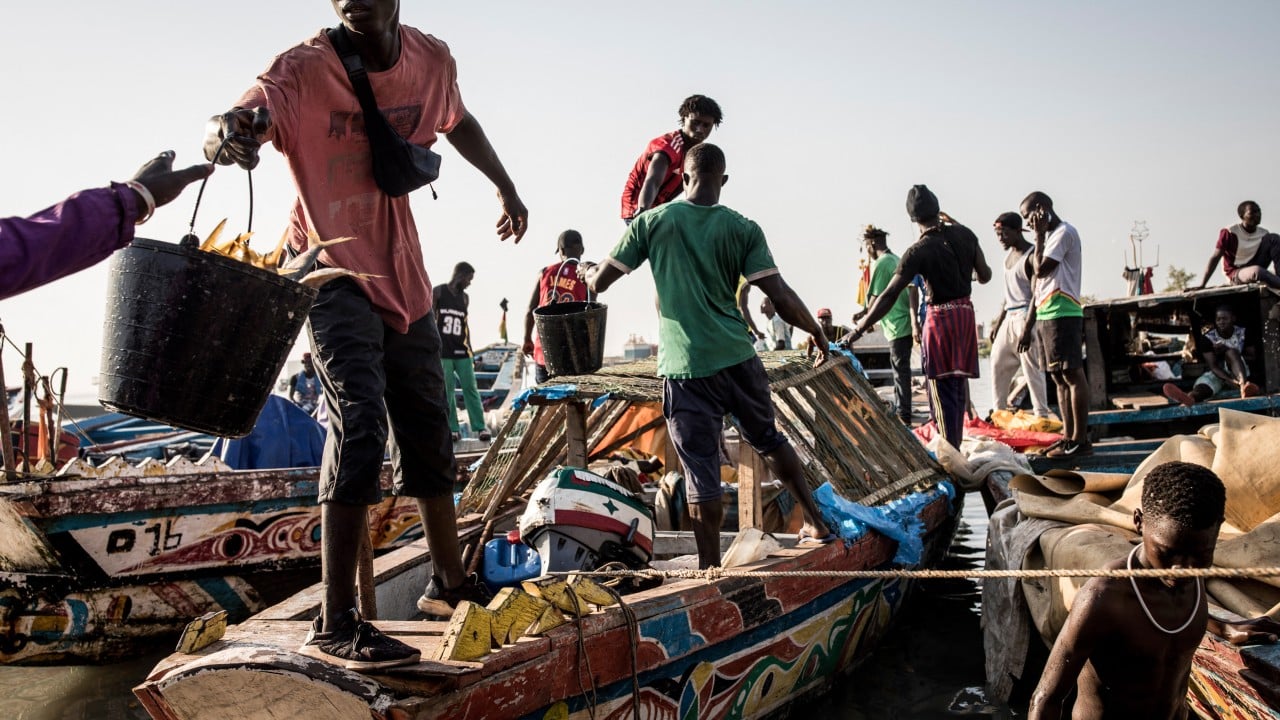
In a small, sun-drenched radio booth in Nairobi, a producer named Samuel adjusts his headset. Outside, the city hums with the kinetic energy of a continent on the move—motorbikes weaving through traffic, the scent of roasting maize, the constant chime of mobile notifications. Samuel isn't thinking about global hegemony. He is thinking about his 7:00 PM slot.
He has two choices for his international segment. He can run a pre-packaged report from a Western wire service that focuses on debt distress and democratic backsliding. Or, he can air a sleek, high-definition feature provided for free by a Chinese media hub, highlighting a new bridge that just cut a three-hour commute down to twenty minutes.
This is the frontline.
It isn't a war of missiles or trade tariffs. It is a quiet, relentless friction over whose story gets told, who gets to tell it, and which version of reality sticks to the ribs of the people living it.
The Signal and the Noise
For decades, the frequency was dominated by the West. The BBC, CNN, and Voice of America were the primary windows through which the world looked at Africa, and through which Africa often looked at itself. The narrative was frequently one of "the dark continent"—a place of perpetual crisis, needing intervention, needing tutelage.
But the airwaves are changing.
Walk through downtown Lagos or Addis Ababa today, and you will see the physical manifestation of a different signal. StarTimes satellite dishes—the Chinese pay-TV giant—dot the rooftops of even the most modest neighborhoods. They aren't just selling hardware; they are selling a perspective. For a few dollars a month, families gain access to hundreds of channels. Amidst the soap operas and football matches, they find news that looks and feels remarkably optimistic.
The Chinese approach to storytelling on the continent is built on a foundation of "constructive journalism." In this framework, the role of the press isn't to be a watchdog or a gadfly. It is to be a partner in development. To a farmer in rural Zambia, a story about a successful irrigation project funded by Beijing is more than just propaganda. It is a glimpse of a future that feels attainable.
Contrast this with the traditional Western media diet. If you only read the major American newspapers, you might believe the continent is a monolith of instability. There is a weariness that comes from being constantly portrayed as a victim. China has recognized this fatigue. They have stepped into the vacuum with a narrative of "win-win cooperation" and "shared destiny."
The words are polished. The production value is staggering. And it is working.
The Invisible Infrastructure of Influence
It is easy to point at a TV screen, but the deeper influence lies in the soil and the wires. Influence follows the fiber optic cables.
Consider the hypothetical—but very real—experience of a young tech entrepreneur in Dakar. When she buys her first smartphone, it’s likely a Transsion brand (Tecno, Infinix, or Itel). When she seeks a loan to scale her business, she navigates an app built on Chinese code. When she walks into a government building to register her trademark, the servers storing her data were likely manufactured and installed by Huawei.
This is the "Digital Silk Road."
The West often critiques this as a "debt trap" or a "surveillance state export." They warn of backdoors in the hardware and the erosion of privacy. These are valid, terrifying concerns grounded in the reality of how data is used in the 21st century. But warnings don't build cell towers.
When a Western diplomat arrives in an African capital, they often bring a lecture on human rights and governance. When a Chinese delegation arrives, they bring a blueprint for a data center and a low-interest loan to pay for it.
The choice for many leaders isn't between a "good" partner and a "bad" partner. It is between a partner who builds and a partner who talks. This creates a psychological debt that is far harder to quantify than a balance sheet. It builds a sense of loyalty that isn't born of ideology, but of utility.
The Language of the Heart
Soft power is a cold term for something very warm and human. It is the music we dance to, the movies that make us cry, and the language we choose to learn.
Washington has Hollywood. The cultural reach of the United States remains its most potent weapon. From Marvel movies to Afrobeats stars who dream of selling out Madison Square Garden, the "American Dream" still has a magnetic pull. It represents a specific kind of individual freedom and creative expression that is deeply seductive to a young, connected population.
However, Beijing is catching up by playing a different game. They are investing heavily in education and language.
Thousands of African students now head to Chinese universities every year, often on full scholarships. They return home not just with degrees in engineering or medicine, but with a fluency in Mandarin and a deep familiarity with Chinese social structures. They become the middle managers of the new economy. They are the translators—not just of words, but of culture.
Across the continent, Confucius Institutes have sprouted up, offering language classes and cultural exchange. They aren't just teaching characters; they are teaching a worldview where stability and collective progress are prioritized over individual dissent.
The Cost of the Echo Chamber
The danger in this "battle for hearts and minds" isn't necessarily that one side will "win." The danger is the fragmentation of truth.
If Samuel in his Nairobi radio booth only plays the Chinese feed, his listeners see a world of frictionless progress where problems are merely technical glitches to be solved by the state. If he only plays the Western feed, they see a world where their home is a permanent tragedy, forever waiting for a savior.
Neither is the whole truth.
The invisible stakes are the agency of the African people themselves. In this tug-of-war between superpowers, the actual voices of the 1.4 billion people living on the continent risk being drowned out. They become the "audience" or the "market" rather than the authors of their own story.
There is a growing resentment toward this binary. You can hear it in the cafes and on the Twitter threads of the continent's youth. They don't want to be a pawn in a new Cold War. They are savvy. They know that when two elephants fight, it is the grass that suffers. But they also know that when two elephants make love, the grass suffers just as much.
The Screen and the Street
The reality of influence is often found in the small, unscripted moments.
It’s in the way a grandmother in a remote village reacts to seeing a Chinese doctor at a mobile clinic. It’s in the way a university student in Lagos uses a VPN to access Western social media sites that his government—using foreign technology—is trying to block.
The West is currently scrambling to "counter" Chinese influence. They are launching initiatives like the "Partnership for Global Infrastructure and Investment." They are hosting high-level summits in Washington. But they are playing catch-up in a game where the rules were changed while they weren't looking.
You cannot win a heart with a white paper. You cannot win a mind with a warning about a debt that hasn't come due yet.
The struggle is over who provides the tools for the future and who provides the narrative for the present. China is winning the "tools" race in many regions, providing the physical and digital skeleton upon which modern Africa is being built. The U.S. and its allies still hold a lead in the "narrative" race, providing the aspirations and the cultural vocabulary of the globalized world.
The Final Frequency
As the sun sets over Nairobi, Samuel finally makes his choice.
He decides to air both. He plays the report on the new Chinese-built railway, but then he interviews a local economist who questions the long-term cost of the maintenance contract. He follows it with a segment on a local tech hub that just received a grant from a Silicon Valley foundation, but he asks the founder why so much of their data is being hosted on servers in Virginia.
He is trying to find a third way.
The battle for the African ear is often framed as a choice between East and West, between capitalism and state-led development, between the "Washington Consensus" and the "Beijing Model." But that is a false choice. The real story is being written by the people who are taking the best of both, discarding the worst of both, and trying to build something that finally sounds like home.
The airwaves are crowded. The signals are clashing. But in the middle of the noise, a new, distinct voice is starting to emerge—one that refuses to be just a loyal listener in someone else’s war.