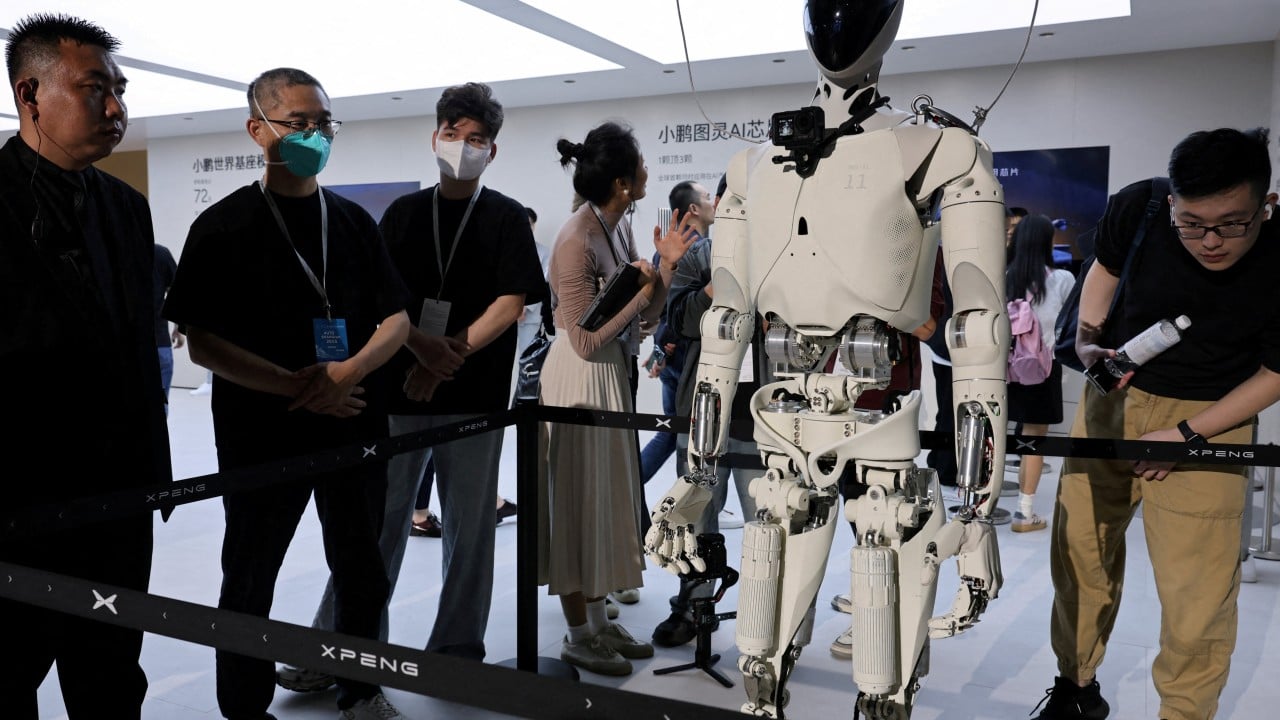
The tech press is currently swooning over China’s state-backed push to flood its factories with humanoid robots. The narrative is comforting, cinematic, and entirely wrong.
Beijing issues a policy directive, central planning kicks into gear, and suddenly, legions of metallic, two-legged workers march onto assembly lines to solve the nation's demographic crisis. It sounds inevitable.
It is a fantasy.
I have spent years auditing automation pipelines and watching hardware companies burn through venture capital. The consensus view—that massive government subsidies and ambitious national roadmaps will create an army of viable, general-purpose humanoid robots by the end of the decade—ignores basic physics, manufacturing economics, and the reality of the factory floor.
China is not building the future of manufacturing. It is funding a massive, state-subsidized hardware distraction.
The Flawed Premise of the "General-Purpose" Savior
The current hype relies on a fundamentally flawed premise: that because a factory is built for humans, the ultimate robot must be shaped like a human.
This is design laziness masquerading as vision.
The human body is an evolutionary compromise, not an optimized industrial machine. We have two legs because we evolved to run away from predators on grasslands, not because bipedalism is an efficient way to bolt a battery pack into an electric vehicle.
When you force a machine to walk on two legs, you introduce an engineering nightmare. You throw away stability. You multiply the points of failure.
Consider the mechanical reality. A bipedal robot requires dozens of high-torque actuators, complex harmonic drives, and constant, millisecond-by-millisecond balance calculations just to stand still. If a six-axis robotic arm loses power, it locks in place. If a humanoid robot loses power, or experiences a software hiccup, a 200-pound mass of expensive carbon fiber and steel crashes into your production line, smashing delicate components and halting operations.
Industrial automation succeeded because it abandoned the human form. We use gantry systems, robotic arms, and automated guided vehicles (AGVs) because they are stable, precise, and mechanically simple. Replacing a highly efficient, specialized $30,000 SCARA arm with a $150,000 humanoid robot just because the humanoid can walk to the breakroom is not progress. It is financial malpractice.
The Kinematic Reality and the 10x Efficiency Tax
Let's look at the actual physics of the factory floor. Industrial efficiency is measured in uptime, repeatability, and cycle time. Humanoids fail every single metric.
To understand why, we need to talk about kinematics and energy expenditure. A wheeled or fixed robot uses energy almost exclusively to perform work. A humanoid robot uses a massive percentage of its energy budget simply defying gravity.
Imagine a scenario where a factory needs to move five-pound components from a conveyor belt to a testing station three feet away.
- The Specialized Solution: A fixed robotic arm handles this with sub-millimeter repeatability, running 24/7 on standard industrial power, with a mean time between failures (MTBF) of 80,000 hours. It costs pennies a day to run.
- The Humanoid Solution: A bipedal robot must walk over, balance itself, extend an arm with far less rigidity, grip the part, turn its entire chassis, walk back, and place it down. It consumes ten times the power, introduces massive vibration that ruins precision, and requires a battery charge every two hours.
State-sponsored programs talk about "embodied AI" as if software can magically override these physical limitations. You can have the most advanced neural network in the world, but it still has to operate through sloppy, overheating actuators and loose mechanical tolerances. Software cannot rewrite the laws of thermodynamics.
The Subsidy Trap: Scaling Garbage
The Chinese Ministry of Industry and Information Technology wants to establish an innovation system for humanoid robots and mass-produce them. But history shows us exactly what happens when central planning forces a technology market before it is mature.
Look at the early days of the Chinese domestic EV market or the current state of their semiconductor initiatives. Government mandates create an explosion of low-quality, copycat companies looking to capture subsidies rather than solve hard technical problems.
Right now, dozens of Chinese startups are revealing humanoid prototypes that look spectacular in highly edited promotional videos. They walk across flat stages. They fold shirts at 5x speed. They pour cups of tea in controlled environments.
What they do not show you are the tethers holding them up during calibration, the teams of engineers off-camera managing the thermal overloads, or the fact that these machines cannot operate for more than 45 minutes without a critical failure.
By forcing mass production before solving the core hardware bottlenecks—specifically power density, actuator torque-to-weight ratios, and tactile sensor reliability—Beijing is subsidizing the creation of expensive junk. They are scaling platforms that are fundamentally unready for the brutal reality of industrial deployment.
The Demographic Myth
The most common defense of this nationwide push is demographic necessity. China’s working-age population is shrinking. The factory workforce is aging out. The narrative claims humanoids are the only way to maintain manufacturing dominance.
This completely misdiagnoses the problem.
Factories do not need humanoids to replace missing humans; they need better process design. The most productive factories in the world—like highly automated automotive plants in Germany or advanced semiconductor fabs in Taiwan—are not empty because they filled seats with androids. They are empty because they re-engineered the entire manufacturing process to eliminate the need for human-like intervention in the first place.
If a manufacturing task requires a human-shaped entity to complete it, that task is poorly designed for automation. The solution is to change the line, update the tooling, or implement specialized automation. Bringing in a humanoid to replicate a human worker’s exact movements is a brute-force workaround that ignores decades of industrial engineering knowledge.
Why Domestic Tech Giants Are Quietly Hedging
While state media trumpets the humanoid dawn, the companies actually running massive logistical operations are quietly taking a different route.
The biggest e-commerce and manufacturing players are not buying bipeds. They are investing heavily in quadrupeds for rugged inspection, advanced AGVs for fulfillment, and smarter, vision-guided cobots for picking. They know what the hype cycle hides: the moment a robot has two legs instead of wheels or a fixed base, its return on investment (ROI) plummets off a cliff.
Amusingly, the loudest proponents of the humanoid factory are tech executives who have never managed a shift on a high-throughput assembly line. They see a cool robotic demonstration and assume it scales. They do not have to worry about the maintenance overhead of managing 500 complex bipedal machines, each with over 40 axes of motion requiring constant calibration.
The Real Cost of Ownership Nobody Talks About
Let’s talk about the math that kills the humanoid dream in industrial settings.
| Metric | Fixed Robotic Arm / AGV | Bipedal Humanoid Robot |
|---|---|---|
| Initial Cost | $20,000 - $40,000 | $100,000 - $250,000+ |
| Degrees of Freedom (Points of Failure) | 4 - 6 | 30 - 50+ |
| Uptime (Battery/Power) | Continuous (Grid Tied) | 2 - 4 Hours (Battery Dependent) |
| Maintenance Interval | Years (Low wear parts) | Weeks (High stress actuators) |
| Precision | Sub-millimeter | Centimeter-level under load |
Even if mass production drops the unit cost of a humanoid to $30,000, the total cost of ownership (TCO) remains catastrophic. The maintenance budget alone will bankrupt the operation. Every joint is a point of failure. Every step creates impact shock that wears down bearings, degrades sensors, and loosens connections.
If a standard industrial robot breaks down, a factory technician swaps a part or reloads a profile in an hour. If a humanoid walks awkwardly, strips a custom harmonic drive in its hip, and falls backward into a conveyor belt, you are looking at catastrophic downtime and specialized repair.
Stop Automating the Form; Automate the Function
The fixation on humanoid robots is a psychological trap. It is the result of science fiction dictating industrial strategy.
China's national program will undoubtedly produce impressive headlines, dazzling exhibitions, and a mountain of academic papers. It will also produce an incredible amount of wasted capital and abandoned hardware.
If you are a manufacturing executive or an investor looking at this space, ignore the state-mandated enthusiasm. Do not look for the robot that looks most like your workers. Look for the system that makes the human form completely irrelevant to your output.
Stop trying to build machines that walk like us. Start building factories that don't need us.