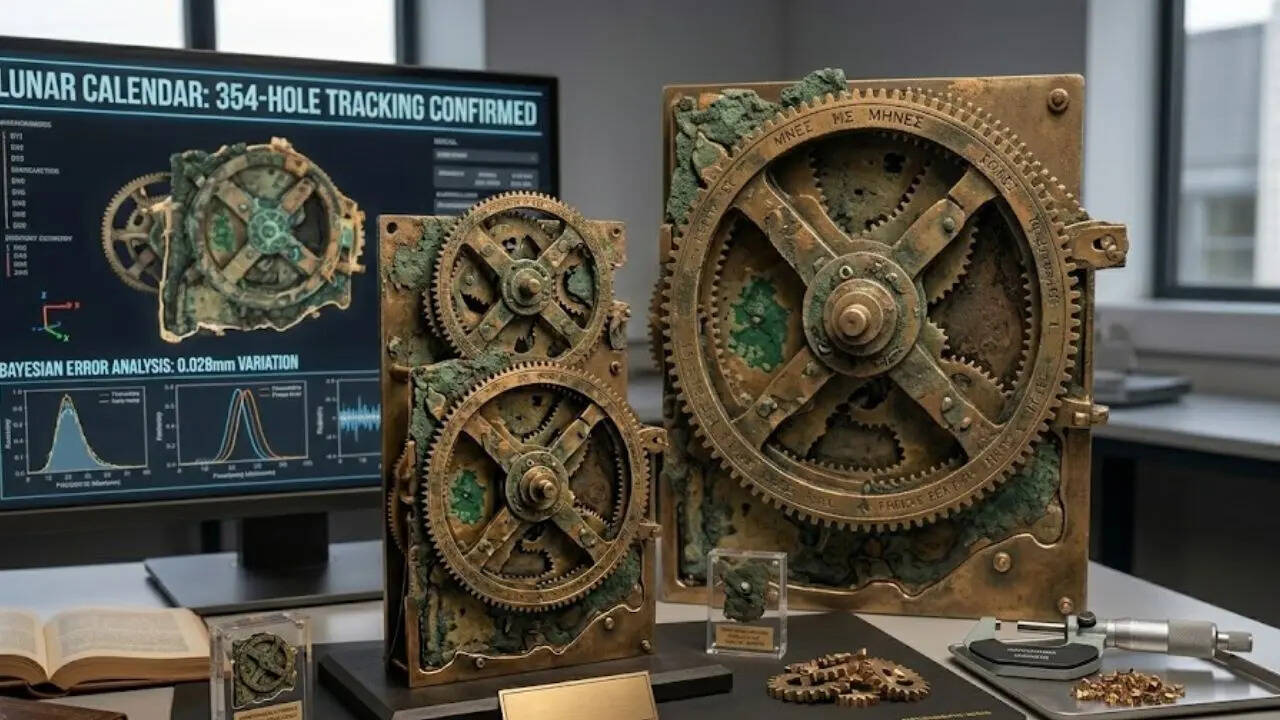
The Antikythera Mechanism is not merely an artifact; it is a proof of concept for the existence of advanced algorithmic thinking two millennia before the industrial revolution. Modern reconstructions, catalyzed by high-resolution X-ray tomography and independent data analysis from the amateur research community, reveal a sophisticated analog computer that utilized differential gearing to solve complex astronomical equations. The device served as a physical manifestation of a predictive model, translating the irregular cycles of the cosmos into a linear, mechanical output.
The Mechanics of Celestial Calculation
At its core, the Antikythera Mechanism operated as a mathematical engine designed to synchronize the solar year with the lunar month. This synchronization is not a simple integer relationship, necessitating the use of specific gear ratios to approximate the Metonic cycle.
- The Metonic Ratio: To align 235 lunar months with 19 solar years, the device required a gear train capable of executing a $235/19$ calculation. This was achieved through a primary drive gear connected to a sequence of smaller, interlocking bronze wheels.
- The Saros Cycle: For eclipse prediction, the mechanism utilized a 223-month cycle. This required a high-tooth-count gear (likely 223 teeth) to track the timing and characteristics of lunar and solar eclipses.
- Epicyclic Gearing: The most advanced feature of the device was its use of a pin-and-slot mechanism. This system replicated the variable speed of the moon’s orbit—an effect caused by its elliptical path—without the Greeks having a formal theory of gravity or elliptical orbits. They solved the problem of "lunar anomaly" through purely geometric and mechanical means.
The Logic of the YouTuber-Scientist Collaboration
The recent breakthroughs in understanding the device highlight a shift in how historical data is processed. While traditional archeology focused on the physical preservation of the bronze fragments, the current phase of discovery relies on digital reconstruction and computational modeling.
The contribution of independent researchers, often dismissed in formal academic settings, centered on the "Calendar Ring" and its hole spacings. By applying statistical analysis to the positions of the remaining holes in the fragmented ring, researchers identified a 354-day lunar calendar rather than a 365-day solar calendar. This discovery corrected a decades-long assumption and forced a recalibration of the entire gear-train model. This feedback loop between "crowdsourced" data analysis and institutional peer review proves that the physical constraints of the artifact dictate the mathematical possibilities of its function. If the holes in the ring represent days, and the distribution follows a specific geometric progression, the mechanical output must align with that progression.
Operational Constraints of Bronze Age Engineering
To assess the brilliance of the Antikythera Mechanism, one must analyze the manufacturing tolerances available in 150-100 BCE. The device was constructed from a single sheet of bronze, with teeth hand-cut into equilateral triangles.
- Friction and Torque: In a system with over 30 gears, cumulative friction poses a significant threat to operational integrity. The hand-cranked input had to generate sufficient torque to move the final pointers without shearing the delicate teeth of the smaller gears.
- Indexing Errors: Without CNC machinery or standardized lathes, every tooth cut by hand introduces a marginal error. In a complex gear train, these errors are compounding. The fact that the device provided accurate predictions suggests that the engineers utilized a form of "error-averaging" or built the system with enough "play" to prevent jamming while maintaining scientific utility.
- The Material Bottleneck: Bronze is durable but prone to corrosion and "cold welding" over centuries under the sea. The mineralization of the gears into a solid block of calcium and oxidized copper means our current understanding is derived almost entirely from X-ray imaging rather than physical disassembly.
The Three Pillars of Hellenistic Computation
The Antikythera Mechanism functions as a bridge between three distinct intellectual domains that rarely intersected in other ancient civilizations.
I. Theoretical Astronomy
The device was built upon the theories of Hipparchus, who studied the moon's varying speed. It demonstrates that the Greeks viewed the universe as a machine governed by predictable, if complex, mathematical laws. The mechanism is the hardware; the Babylonian-derived astronomical data is the software.
II. Precision Metallurgy
The ability to calculate the gear ratios is useless without the ability to manufacture them. The presence of such a device implies the existence of a high-end workshop tradition—a "technological ecosystem"—that has largely vanished from the archeological record because bronze was frequently melted down for weaponry.
III. User Interface Design
The dials on the back of the device were not meant for scientists, but for users. They featured "Parapegma" (calendars) that synced astronomical events with local social events, such as the Olympic Games. This represents an early instance of "data visualization," where complex backend calculations are simplified into an easy-to-read front-end display.
Why the Technology "Disappeared"
A common logical fallacy is that if a technology exists, it must inevitably lead to an industrial revolution. The Antikythera Mechanism was a "dead end" for two primary reasons:
- Lack of Interchangeable Parts: Each device was a bespoke masterpiece. Without the ability to mass-produce standardized gears, the technology remained an elite luxury rather than a foundational tool for navigation or commerce.
- The Socio-Economic Barrier: In a society powered by slave labor, there was little economic incentive to automate labor. The mechanism was a calculator for prestige and prediction, not a tool for production.
Reconstructing the Gear Train Model
To build a functional replica today, we must map the relationship between the drive wheel and the astronomical outputs. The system follows a modular architecture:
- Input: A side-mounted crank represents the passage of time.
- Primary Distribution: A large central gear (the four-spoked "sun gear") drives the solar and lunar pointers.
- Differential Sub-systems: A differential gear—a concept once thought to have been invented in the 18th century—was used to subtract the sun's motion from the moon's motion to show the moon's phase. This is the highest level of mechanical logic found in the device.
The mathematical model for the differential can be expressed as:
$$\omega_{output} = \frac{\omega_{sun} - \omega_{moon}}{2}$$
This allows the "Moon Phase" dial to rotate at a speed that accurately reflects the synodic month, the time between new moons.
The Mechanism as a Philosophical Shift
The existence of the Antikythera Mechanism challenges the linear narrative of technological progress. It suggests that human history is not a steady upward slope but a series of peaks and troughs. We are looking at a peak of "Analog Integration" that would not be seen again until the clockwork of the Renaissance.
The "data leads" provided by modern analysis confirm that the device was more accurate than the telescopes of the 1600s in certain predictive aspects. This was achieved through the sheer brute-force application of geometry. The Greeks did not know why the planets moved the way they did, but they knew how they moved with enough precision to build a bronze simulation of it.
Strategic Implications for Modern Analysis
The study of the Antikythera Mechanism offers a template for decoding complex systems where the "source code" is missing.
- Reverse Engineering from Output: By observing the dial requirements (e.g., a 223-month cycle), one can mathematically deduce the necessary internal components even if they are missing from the physical fragments.
- Data-Driven Skepticism: The "354-day" lunar ring discovery shows that long-standing expert consensus can be overturned by a single rigorous re-examination of raw data.
- Interdisciplinary Synthesis: Understanding the device requires a simultaneous grasp of history, astronomy, metallurgy, and mechanical engineering.
The mechanism proves that the limiting factor in ancient technology was not the capacity for complex thought, but the scalability of precision manufacturing. The logic was perfected; the infrastructure was not. To understand the future of computing, one must recognize that the desire to simulate the complexity of the world in a controllable, mechanical format is a fundamental human drive that predates the transistor by two thousand years.
The path forward for researchers lies in the application of AI-driven image enhancement to the faintest inscriptions on the device’s "User Manual"—the bronze plates covering its exterior. These inscriptions likely contain the remaining "operating system" instructions that will finalize our understanding of the planetary gears, which are currently the most speculative part of the reconstruction. Focus must remain on the mathematical constraints of the gear ratios; any hypothesized gear must fit within the physical volume of the case and align with the known celestial cycles. There is no room for "missing links" that do not obey the laws of gear geometry.