A pair of recently published deep-sea video recordings have accomplished what marine biologists have spent over a century trying to achieve: capturing the elusive goblin shark (Mitsukurina owstoni) thriving in its natural, undisturbed habitat. For generations, our understanding of this 125-million-year-old evolutionary lineage was restricted to dying, mangled specimens inadvertently dragged to the surface by commercial fishing lines.
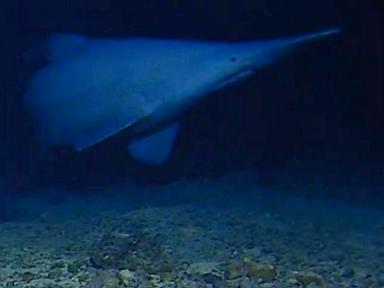
The new data, published in the Journal of Fish Biology by a team led by the University of Hawaiʻi at Mānoa, changes everything we thought we knew about their geographic and vertical limits. One individual was recorded by a remotely operated vehicle (ROV) at a depth of 1,237 meters near Jarvis Island in the Central Pacific, shattering previous assumptions that the species was confined to narrow coastal margins off Japan, Australia, and California. The second, documented on a baited bottom lander camera in the Tonga Trench, was found nearly 2,000 meters down. This represents a staggering 697-meter depth extension for the species, proving that these animals survive much deeper than previously documented.
Yet, behind the media celebration lies a much more sobering reality. The fact that it took until now to secure mere seconds of healthy, in situ footage exposes a critical structural failure in oceanographic science: our deep-sea exploration frameworks are fundamentally broken, underfunded, and reliant on historical flukes rather than systematic research.
The Illusion of Discovery
The public sees the headline and imagines an intentional, highly coordinated scientific triumph. The truth of how these videos came to light reveals a vastly different story of administrative backlogs and sheer luck.
The Jarvis Island footage was not captured by a team actively hunting for the legendary shark. It was filmed way back in 2019 during an expedition by the E/V Nautilus, a research vessel operated by the Ocean Exploration Trust. At the time, the onboard crew watched the creature swim past their livestreamed ROV camera, but because deep-sea expeditions generate thousands of hours of video, the moment was effectively lost in a massive digital archive.
It sat unstudied for years until Aaron Judah, a doctoral candidate at UH Mānoa, heard rumors of a potential sighting while chatting with colleagues in 2025. Judah had to manually comb through years of archived footage to verify that scientists had, in fact, recorded a 3.4-meter-long adult male goblin shark six years prior.
Deep-Sea Data Bottleneck:
[Expedition (2019)] ──> [Thousands of Hours of Video] ──> [Unannotated Digital Archive] ──> [Accidental Discovery (2025)]
This reliance on retrospective luck is a direct symptom of an industry-wide data bottleneck. Governments and private donors are eager to fund high-tech ROV deployments because they make for spectacular press releases.
They rarely fund the unglamorous, tedious labor required to analyze the resulting data. Millions of dollars are spent dropping cameras into the trenches, only for the footage to collect dust on university servers because there are not enough paid hours for researchers to watch it.
What the Flesh Distorts
To understand why this footage is crucial, one must look at how the goblin shark has been fundamentally misrepresented by science since its discovery in 1898. Nearly every famous photograph of a goblin shark features a grotesque, pinkish monstrosity with a terrifying jaw thrust forward like something out of a horror film.
That distorted image is an artifact of death. The goblin shark possesses a highly specialized slingshot feeding mechanism. When hunting in the food-poor abyssal plains, it utilizes an elastic jaw mechanism that can fire forward at maximum velocities of up to 3.1 meters per second, extending nearly 10% of its total body length to catch fast-moving prey.
When these animals are caught on fishing lines and hauled through catastrophic pressure and temperature gradients to the surface, their muscles spasm, suffocating them while locking their jaws into that fully extended, unnatural position. The pinkish, flabby hue seen in specimens is actually tissue damage and bruising from decompression.
The new in situ video footage reveals a completely different animal. In its natural habitat, the goblin shark is ghostly white, almost ethereal. Its infamous jaw is kept entirely retracted inside its head, blending smoothly into its profile beneath its long, sensitive rostrum.
The creature does not cruise through the dark as an aggressive predator; it drifts with a slow, highly efficient metabolism, using the Ampullae of Lorenzini coating its horn-like nose to detect the faint electrical pulses of hidden prey in the pitch black. Science has spent 128 years analyzing a corpse and calling it a portrait.
The Deep Sea Funding Desert
If the ocean covers over 70% of the planet, the abyssal zones remain a financial afterthought. Space exploration routinely secures billions of dollars in public and private capital, driven by national pride and corporate satellite interests. Meanwhile, deep-sea research is treated like a boutique academic hobby.
The Tonga Trench observation, which pushed the known depth boundary of these ancient sharks down to the 2,000-meter mark, only happened because of an independent expedition funded by Inkfish, a private philanthropic organization, using the research vessel R/V Dagon.
Without the intervention of private billionaires willing to bankroll deep-sea landers, the Western Pacific data point would simply not exist. Relying on the whims of wealthy patrons is an unstable foundation for global environmental policy.
Because we lack a systematic, state-funded mapping and monitoring initiative for the deep ocean, we are making critical environmental decisions in total blindness. Deep-sea mining corporations are currently lobbying international regulatory bodies for permits to strip-mine seamounts and abyssal plains for manganese nodules. They claim these environments are sterile wastes.
The discovery of an ancient apex predator operating 700 meters deeper than previously recorded completely upends that narrative. If we do not even know where the ocean's oldest lineages live, we cannot possibly calculate the ecological fallout of destroying their habitats.
Moving Beyond the Accidental
The inclusion of the goblin shark in regional biodiversity lists and marine resource management plans can now occur only because these two random snippets of video finally proved their geographic presence. This cannot remain the standard operating procedure for marine biology.
To fix this, the scientific community must pivot away from merely accumulating raw footage and invest heavily in automated video analysis and machine-learning frameworks designed to flag anomalous biological structures in deep-sea streams.
Furthermore, public environmental funding must match the scale of the commercial interests currently looking to exploit the seabed. Finding a living fossil at 2,000 meters should be a wake-up call, a stark reminder that the deep ocean is not an empty desert, but a highly complex, fragile ecosystem that we are on the verge of disrupting before we even understand it.