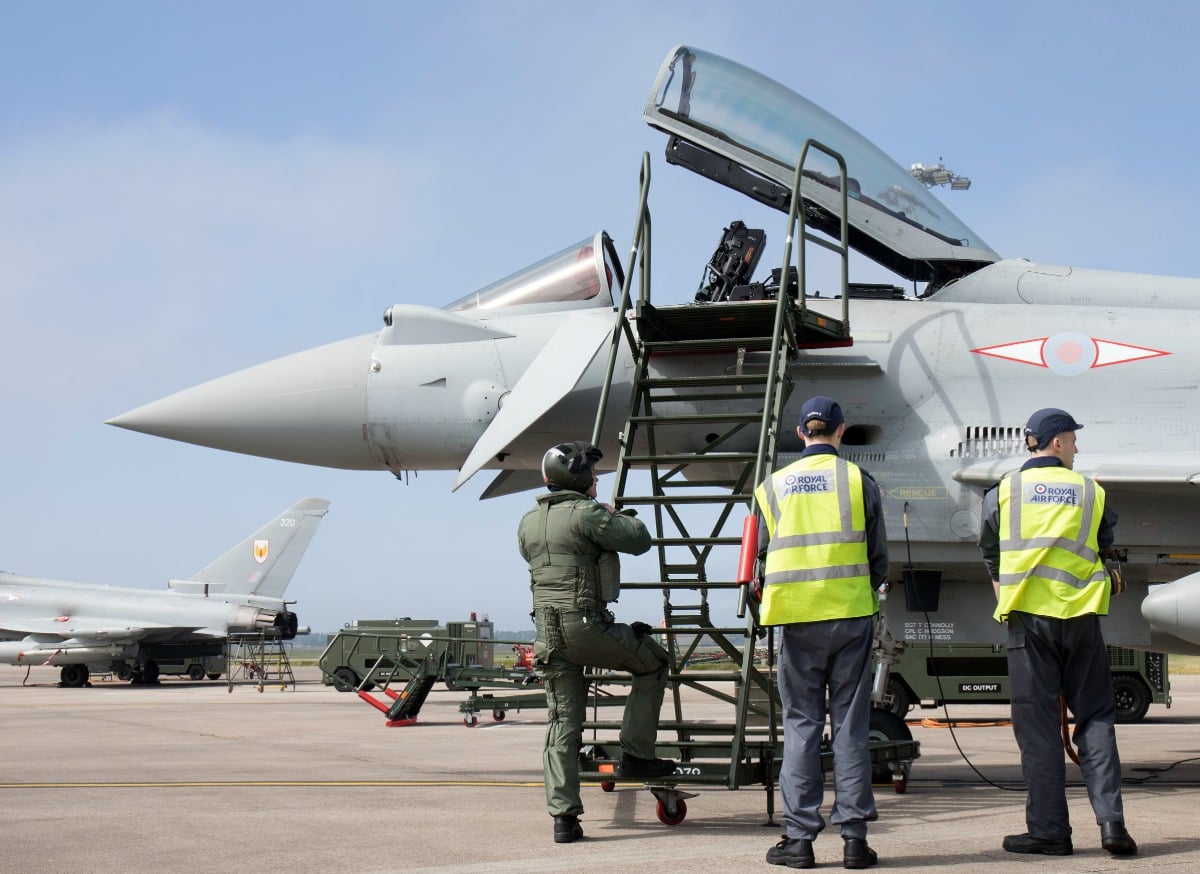
The procurement of military aviation support rests on a single structural tension: the trade-off between operational readiness and lifecycle cost insulation. When the UK Ministry of Defence secures long-term support agreements for platforms like the Eurofighter Typhoon, the transaction is not merely a purchase of spare parts or maintenance hours. It is an explicit transfer of systemic risk from the state to the defense industrial base. The recent agreement involving Leonardo to sustain the UK Royal Air Force’s combat air fleet demonstrates how modern defense contracting utilizes availability-based economics to guarantee frontline capability while attempting to stabilize public expenditure.
Understanding this mechanism requires breaking down the traditional material support model versus modern availability contracts. Historically, defense logistics operated on a transactional, piece-rate framework—often termed "spares and repairs." Under that model, the industrial supplier profited from system failures; the more components that broke, the more volume the contractor processed. This created misaligned incentives, where the state bore the financial burden of reliability deficits. The transition to long-term availability frameworks inverts this dynamic. The state buys an agreed-upon level of fleet readiness, shifting the cost of component unreliability entirely onto the prime contractor.
The Operational Architecture of Combat Air Support
To evaluate the strategic value of the Leonardo contract, one must dissect the electronic warfare and radar subsystems that form the core of modern warplane survivability. Combat aircraft like the Typhoon rely on integrated defensive aids sub-systems to detect, identify, and counter threats in contested airspace. Ensuring the constant readiness of these highly complex, software-defined hardware suites requires a continuous engineering loop that spans three distinct levels of maintenance.
- Forward Maintenance (O-Level): Conducted at the operational squadron level, focusing on rapid diagnostics, line-replaceable unit swapping, and flight-line validation.
- Depth Maintenance (I-Level): Performed at centralized hub facilities, involving deeper component diagnostics, modular repairs, and localized software patching.
- Base-Level Overhaul (D-Level): Executed at the original equipment manufacturer's facilities, requiring full system teardowns, structural recertification, and major architectural upgrades.
The Leonardo arrangement consolidates these levels into a singular, integrated support pipeline. By embedding contractor personnel directly alongside Royal Air Force technicians, the contract eliminates the traditional friction points found in bureaucratic supply chains. This hybrid footprint accelerates the diagnostic phase of the maintenance cycle, reducing the time an aircraft spends grounded due to subsystem anomalies.
The Mathematics of Availability-Based Contracts
The core efficiency of this agreement depends on a mathematical formulation of fleet availability. A defense ministry does not measure value by the number of engineering tasks completed, but by the probability that an aircraft is fully mission-capable at a specific point in time. This can be expressed through the operational availability formula:
$$A_o = \frac{MTBM}{MTBM + MDT}$$
Where $MTBM$ represents the Mean Time Between Maintenance (both preventive and corrective) and $MDT$ represents the Mean Down Time, which includes active maintenance time, logistic delay time, and administrative delay time.
Under standard procurement models, the state struggles to control $MDT$ because supply chain delays, transportation bottlenecks, and spare parts shortages remain fragmented across various sub-contractors. The long-term support contract solves for this by penalizing the contractor if $MDT$ exceeds strict thresholds. Because Leonardo manages both the manufacturing data rights and the supply chain architecture, they can optimize the distribution of spare parts globally, ensuring that high-failure-rate components are pre-positioned near operational bases. This reduces the logistical delay component of $MDT$ toward zero.
The financial risk for the contractor increases with contract length, yet so does the potential for profit maximization. If the contractor can invest in predictive maintenance technologies—using sensor data analytics to predict a component failure before it occurs—they can increase $MTBM$ and schedule maintenance during routine down periods. The cost savings generated by avoiding catastrophic component failures and emergency shipping are retained by the contractor as margin, while the military receives its guaranteed uptime.
Sovereign Capability as a Strategic Moat
Beyond the financial calculus, the retention of domestic engineering expertise is a critical requirement of national security strategy. Sovereign industrial capability refers to a state's ability to maintain, modify, and upgrade its military assets independent of foreign political or bureaucratic intervention. The UK’s reliance on domestic facilities for combat air support ensures that during a peer-to-peer conflict, the modification of electronic warfare suites can happen in real-time response to emerging theater threats.
If a state abdicates this capability to foreign suppliers, it creates a dangerous vulnerability. During active operations, foreign nations may prioritize their own domestic fleets, or political shifts might cause them to withhold software source codes or critical components. Retaining a deeply competent engineering workforce within the UK borders—specifically at sites dedicated to advanced sensor integration and radar development—functions as an operational force multiplier.
This domestic footprint creates a secondary economic effect: the preservation of high-value systems engineering skills within the national economy. These specialized skills are non-fungible. If a engineering team specializing in active electronically scanned array radar systems is disbanded due to a gap in domestic funding, rebuilding that capability takes a decade. The continuity provided by long-term support agreements ensures that the underlying intellectual property and human capital remain intact, ready to be deployed on next-generation platforms like the Global Combat Air Programme.
Critical Vulnerabilities in Long-Term Defense Monopolies
While the benefits of availability contracts are clear, an objective analysis reveals structural risks that the state must mitigate. The primary hazard is lock-in. When a single prime contractor secures a long-term, multi-year support agreement for proprietary subsystems, it effectively eliminates market competition for the duration of that platform's lifecycle.
The consequences of this monopoly manifest in several areas:
- Price Discovery Failure: Without competing bids, the Ministry of Defence cannot easily verify if the baseline cost of support reflects true market efficiency or inflated contractor margins.
- Innovation Stagnation: The contractor may focus entirely on optimizing the reliability of existing components to maximize their current contract margin, rather than investing capital into radical, next-generation upgrades that could render the current architecture obsolete.
- Data Asymmetry: The contractor owns the granular reliability data generated by the aircraft systems. If the state does not aggressively negotiate data-sharing rights, it becomes blind to the actual performance metrics of its own fleet, weakening its bargaining position during subsequent contract renewals.
To counteract these dynamics, modern defense frameworks must employ open systems architectures in software and hardware design. By forcing contractors to build subsystems to common industry standards, the state retains the theoretical ability to unbundle the support contract in the future, introducing third-party competition for specific components or software modules.
Executing the Next-Generation Support Paradigm
To maximize the return on investment for the duration of this aviation support agreement, defense acquisition managers must pivot from reactive oversight to data-driven contract enforcement.
First, the state must establish a shared data lake where raw sensor telemetry from the aircraft is co-owned by both the military and the contractor. This eliminates data asymmetry and allows independent government analysts to verify the contractor’s uptime metrics.
Second, incentive structures must be indexed to operational outcomes rather than static availability percentages. For example, a flat 95% availability target is less valuable than a dynamic target that guarantees 100% availability during high-intensity exercise windows, balanced by lower requirements during scheduled fleet reset periods.
Finally, the transition planning for the next generation of combat air must begin within the envelope of this current support structure. The engineering lessons, component failure modes, and operational flight data gathered under this agreement must be systematically fed directly into the design phase of future platforms. This creates a closed-loop development cycle, ensuring that the operational insights bought with today's taxpayers' funds directly reduce the lifecycle cost functions of tomorrow's fleets.