California’s statutory mandate to achieve a zero-carbon electrical grid requires adding more than 40 gigawatts of new energy resources to its system. However, the physical reality of resource allocation creates a fundamental spatial mismatch: the state’s highest-yielding renewable generation assets are concentrated in peripheral areas like the Imperial Valley, while primary demand centers sit along the coastal megalopolis. The proposed Golden Pacific Powerlink—a 145-mile, 500-kilovolt (kV) transmission line designed by San Diego Gas & Electric (SDG&E)—seeks to bridge this gap but exposes a critical structural paradox: the optimization of clean energy transmission requires the industrialization of protected ecosystems.
By slicing through the heart of Anza-Borrego Desert State Park, the project transforms a straightforward engineering problem into a multi-variable optimization failure. Resolving this friction requires evaluating the grid through precise operational trade-offs rather than emotional rhetoric.
The Capacity Calculus and the Imperial-Orange Bottleneck
To evaluate the necessity of the Golden Pacific Powerlink, the grid must be viewed as a thermodynamic and economic system governed by capacity constraints. The California Independent System Operator (CAISO) identified this infrastructure asset within its transmission planning framework as a requirement for grid stability. The system operates under strict physical parameters.
The Upstream Generation Surfeit
The Imperial Valley serves as a primary point of interconnection for utility-scale solar and geothermal generation. Because generation capacity during peak solar hours vastly exceeds local load requirements, the excess energy must be exported. Without high-capacity transmission, this power is subject to economic curtailment, rendering billions in renewable capital investments underutilized.
Downstream Congestion and Voltage Stability
As coastal generation assets—specifically older, gas-fired peaker plants—are phased out to meet climate mandates, the coastal grid loses both its baseload capacity and its rotational inertia. Importing large quantities of power over long distances requires robust thermal capacity to avoid line sag and voltage collapse. A 500-kV line represents the highest voltage class utilized in regional transmission, designed to minimize resistive line losses ($I^2R$) over long distances.
The Alternative Infrastructure Dilemma
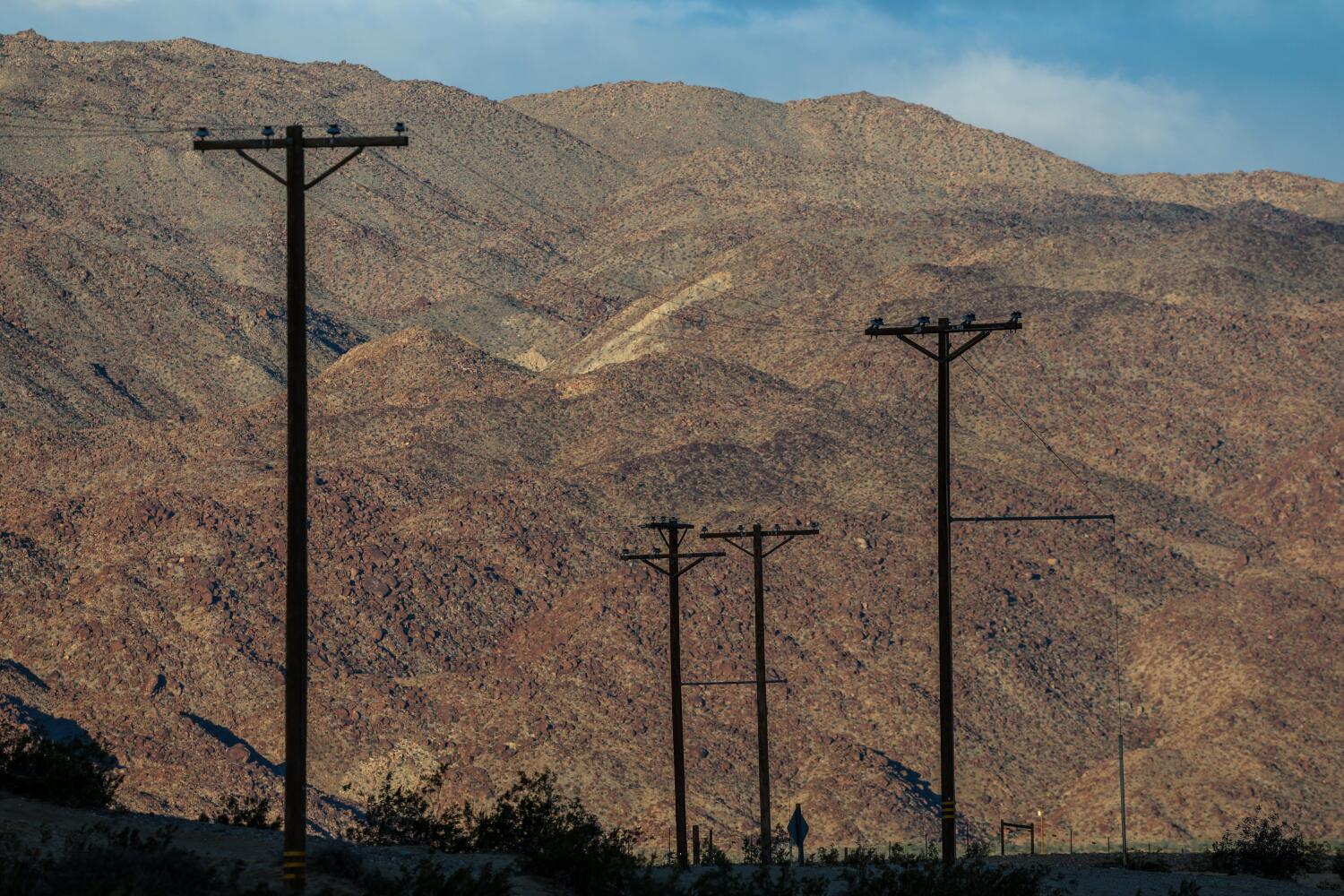
Critics frequently propose reconductoring existing lower-voltage lines or deploying distributed rooftop solar as frictionless alternatives. This perspective overlooks the physics of utility-scale power systems. Reconductoring—replacing existing lines with advanced composite conductors—increases thermal capacity but does not change the systemic topology or voltage class. The existing internal corridor within Anza-Borrego consists of a legacy 69-kV line mounted on wooden poles dating back to 1933. Upgrading a 69-kV line to a 500-kV system is not an incremental modification; it requires an entirely different engineering scale, including massive steel lattice towers averaging 150 to 200 feet in height and extensive concrete footings.
Distributed rooftop solar, while reducing local distribution load, lacks the centralized dispatchability, industrial scale, and battery storage integration required to stabilize the macro-grid during the post-sunset ramping period known as the duck curve. Consequently, macro-transmission corridors remain structurally irreplaceable for state-level decarbonization.
The Tri-Border Cost Function: Calculating Environmental and Social Friction
The deployment of a utility-scale transmission corridor cannot be measured solely by its construction capital expenditure, currently estimated at $2.3 billion. The true economic cost includes negative externalities distributed across three distinct vectors: ecological integrity, regional economic stability, and localized environmental justice.
1. Ecological Fragmentation Vectors
Anza-Borrego Desert State Park represents a highly biodiverse desert ecosystem. The introduction of an industrial infrastructure corridor introduces several distinct environmental degradation vectors:
- Habitat Fragmentation: The construction of 500-kV towers requires wide rights-of-way, heavy machinery access roads, and permanent grading. For the federally endangered Peninsular bighorn sheep (Ovis canadensis nelsoni), these corridors function as psychological and physical barriers, dividing critical foraging grounds and altering established migratory pathways.
- Acoustic and Electromagnetic Disruption: High-voltage lines produce a continuous corona discharge, resulting in audible low-frequency humming and localized electromagnetic fields. This industrial footprint disrupts avian and nocturnal wildlife communication, navigation, and hunting behaviors.
- The Development Magnet Effect: Historical infrastructure data demonstrates that once a major utility corridor is legally established through a protected area, it operates as a regulatory path of least resistance. The initial 500-kV line establishes a precedent that lowers the future bureaucratic threshold for ancillary substations, switchyards, and secondary distribution lines, compounding the long-term ecological footprint.
2. The Tourism-Dependent Economic Penalty
The regional economy of the backcountry and desert communities relies heavily on eco-tourism driven by the park’s wilderness designation. The conversion of a pristine viewshed into an industrial energy corridor alters the economic value of the asset.
[Visual Landscape Disruption] ──> [Reduction in Eco-Tourism Volume] ──> [Capital Outflow from Local Hospitality/Retail]
The monetization of "dark skies" and undisturbed desert vistas attracts a predictable annual influx of capital to hospitality, guiding, and retail sectors in communities like Borrego Springs. Introducing high-voltage infrastructure risks permanently suppressing visitor volume, shifting the economic burden of coastal energy reliability onto rural economies.
3. Asymmetric Resource Extraction
The Golden Pacific Powerlink originates in the Imperial Valley and terminates at the San Diego-Orange County border. This geographic routing highlights a classic environmental justice asymmetry. The Imperial Valley frequently hosts large-scale resource-generation projects that yield minimal local socio-economic returns. The construction phase creates temporary, transient labor opportunities, but the long-term operational phase yields negligible permanent employment. Local residents incur the environmental and agricultural disruptions of infrastructure proximity, while the premium power, grid stability, and corporate profits flow directly to affluent coastal coastal demand centers.
The Regulatory Battleground: CEQA as a Tool for Delay and Redesign
The ultimate trajectory of the Golden Pacific Powerlink will not be decided by engineering efficiency or ecological advocacy alone, but by California’s complex regulatory architecture. The central mechanism of resistance is the California Environmental Quality Act (CEQA).
Historically designed to protect public health and ecosystems from unmitigated industrial pollution, CEQA has evolved into a powerful legal mechanism used by stakeholder groups to stall or terminate infrastructure development. The preparation of an Environmental Impact Report (EIR) for a 145-mile project requires thousands of pages of granular scientific analysis covering paleontology, hydrology, cultural resources, and wildfire risk.
The structural risk for SDG&E lies in the vulnerability of the EIR to litigation. Opponents systematically audit these documents for technical omissions, using subsequent lawsuits to trigger injunctions. In California’s regulatory environment, a prolonged timeline acts as an economic death sentence; a five-to-ten-year delay due to litigation exposes capital expenditures to inflation, rising material costs, and shifting political landscapes.
The historical precedent of the Sunrise Powerlink is instructive. Originally proposed in the mid-2000s to cut directly through Anza-Borrego, intense public opposition and regulatory friction under CEQA ultimately forced a massive, multi-million-dollar rerouting around the park’s southern boundary. The current iteration of the Golden Pacific Powerlink attempts to re-litigate this exact spatial conflict, gambling that the state's urgent statutory climate deadlines will compel the California Public Utilities Commission (CPUC) to override local environmental opposition.
However, legislative attempts to fast-track grid infrastructure by exempting state parks from standard CEQA reviews—such as the recent defeat of provisions within Assembly Bill 3238—demonstrate that the political consensus protecting state parks remains resilient, even in the face of a looming energy crisis.
Strategic Matrix of Grid Integration Alternatives
To navigate this impasse, planners must evaluate options using a multi-criteria optimization matrix that balances capital expenditure, regulatory execution risk, environmental degradation, and long-term grid resilience.
| Alternative Strategy | Capital Expenditure | Regulatory/CEQA Risk | Environmental Impact | Grid Reliability Contribution |
|---|---|---|---|---|
| Proposed Route (Direct Through Park) | Baseline ($2.3B) | Extreme Risk | Severe (High Fragmentation) | Maximum (Direct, Low Loss) |
| Southern Reroute (Circumnavigation) | Elevated (+30-50% Cost) | Moderate Risk | Moderate (Avoids Deep Park Wilderness) | High (Longer Distance, Minor Loss) |
| Subterranean / Highway Corridor | Prohibitive (3-5x Cost) | Low-Moderate Risk | Low-Moderate (Confined to Caltrans ROW) | High (Protected from Fire/Weather) |
| Advanced Reconductoring + Localized Storage | Low-Moderate | Low Risk | Minimal | Moderate (Fails to Add New Corridor) |
The Definitive Strategic Play
The current strategy pursued by SDG&E and CAISO—pushing a 500-kV corridor directly through a highly protected state park—is structurally unviable. The regulatory friction generated by CEQA, combined with organized resistance from well-capitalized conservation foundations and local communities, guarantees an extended litigation timeline that will ultimately defeat the project's scheduling objectives.
The optimal strategic path forward requires an immediate pivot away from the direct Anza-Borrego alignment toward a synchronized two-pronged deployment:
- Execute a Southern Circumnavigation Route: Utility executives must accept the higher capital cost of a longer routing that bypasses the park's core wilderness assets, utilizing existing state highway rights-of-way and disturbed agricultural corridors. This immediately lowers the regulatory risk profile and eliminates the highest-probability CEQA lawsuits.
- Deploy Advanced Composite Reconductoring on Coastal Peripheries: Concurrently, the utility must optimize existing coastal transmission pathways by swapping traditional steel-reinforced aluminum conductors for advanced carbon-fiber core conductors. This rapidly increases the thermal capacity of the existing network, providing an immediate stopgap for energy imports while the primary southern transmission corridor undergoes its streamlined environmental review.
Continuing to force an industrial high-voltage line through a protected wilderness area under the banner of green energy is an operational error. True grid modernization requires decoupling clean energy delivery from the destruction of the natural assets the transition was originally designed to preserve.