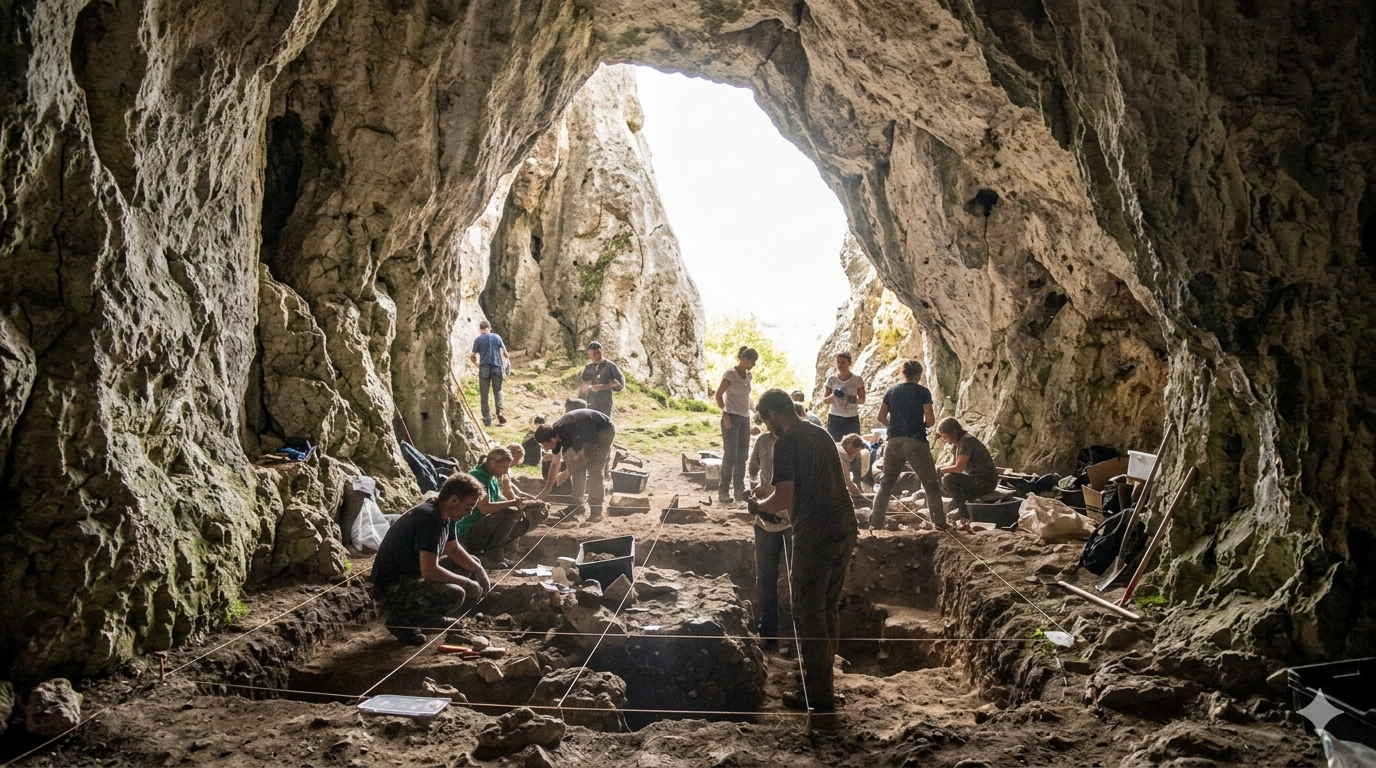
The recovery and sequencing of mitochondrial DNA (mtDNA) from the Stajnia Cave S5000 molar provides a rare empirical anchor for the Marine Isotope Stage (MIS) 5a period, identifying a specific lineage of Neanderthals that inhabited Central-Eastern Europe approximately 80,000 years ago. This discovery shifts the understanding of Neanderthal demographic history from a model of static regional occupation to one defined by high-frequency migratory cycles and population replacements driven by the unstable climate of the Late Pleistocene.
The Genomic Architecture of S5000
The Stajnia S5000 specimen represents the oldest Neanderthal remains found in Central-Eastern Europe to date. The analysis centers on the mitogenome—the circular DNA found within mitochondria—which is inherited maternally and serves as a high-resolution molecular clock. By comparing the S5000 mitogenome against a global dataset of Neanderthal sequences, researchers identified a distinct genetic proximity to the Mezmaiskaya 1 individual from the Caucasus, rather than the contemporaneous populations found in Western Europe (such as those from Scladina or Hohlenstein-Stadel).
The genetic distance was calculated using the formula for molecular divergence:
$$d = 2\mu t$$
where $d$ is the number of substitutions, $\mu$ is the mutation rate, and $t$ is the time since the last common ancestor. The results indicate that the Stajnia lineage diverged from other European Neanderthals during a period of significant environmental flux, suggesting that the Altai-like Neanderthal populations were replaced in the West by a lineage more closely related to those found in the Caucasus.
Environmental Constraints and the Micoquian Lithic Tradition
The presence of the S5000 individual coincides with the Micoquian tool-making tradition, characterized by distinct asymmetrical bifacial knives. The correlation between the genetic signature and this specific material culture suggests a "techno-complex" that likely facilitated the expansion of these populations into the harsher, more seasonal environments of the North European Plain.
The survival of these groups was dictated by two primary environmental variables:
- Thermal Stress Thresholds: The fluctuating temperatures of MIS 5a required high caloric intake and advanced hide-processing technology.
- Resource Patchiness: The mammoths and woolly rhinoceroses of the steppe-tundra moved in unpredictable patterns, forcing Neanderthals to adopt high-mobility strategies.
The Micoquian tools found at Stajnia Cave are not merely artifacts; they are the functional output of a specific survival strategy. These tools provided a mechanical advantage in processing large game in cold climates where fat and marrow extraction were essential for metabolic maintenance.
The Replacement Model vs. The Continuity Hypothesis
Prior to the sequencing of S5000, two competing models dominated the discourse regarding Neanderthal history in Central Europe. The Continuity Hypothesis suggested a stable, long-term occupation of the region by a single lineage. The Replacement Model, supported by the Stajnia data, posits that local populations were frequently extirpated during cold peaks and subsequently recolonized by groups from southern refugia.
The S5000 mitogenome acts as a diagnostic marker for this replacement. Its similarity to the Mezmaiskaya 1 specimen indicates a long-range dispersal event. This suggests that the Altai-related Neanderthals, who had previously occupied parts of Europe, were pushed out or outcompeted by a "West Eurasian" lineage that was better adapted to the shifting ecosystems of the mid-to-late Pleistocene.
Methodological Rigor in Ancient DNA Extraction
The extraction of DNA from an 80,000-year-old molar requires a specialized pipeline to mitigate the "Post-Mortem Damage" (PMD) characteristic of ancient sequences. DNA undergoes spontaneous deamination over time, where cytosine residues are converted to uracil, appearing as cytosine-to-thymine (C to T) transitions at the ends of the DNA fragments.
The Stajnia analysis employed a multi-stage validation process:
- Contamination Screening: Quantifying the ratio of modern human DNA to Neanderthal DNA to ensure the signal was endogenous.
- Damage Pattern Analysis: Verifying the presence of C to T transitions at the 5' and 3' termini, a hallmark of authentic ancient DNA.
- Phylogenetic Placement: Utilizing Bayesian inference to determine the most likely position of S5000 on the Neanderthal evolutionary tree.
This level of precision is necessary because the temperate conditions of Central Europe are less conducive to DNA preservation than the permafrost of Siberia. The successful recovery of a full mitogenome from Stajnia Cave represents a significant technical milestone in the field of paleogenomics.
Demographic Bottlenecks and Genetic Diversity
The Stajnia DNA reveals a population with low genetic diversity, a common trait among Neanderthals. This low effective population size ($N_e$) suggests that these groups lived in small, isolated bands. In population genetics, the effective population size is defined as the number of individuals in a theoretical population that would have the same amount of genetic diversity as the actual population.
The low $N_e$ of Neanderthals in MIS 5a had several functional consequences:
- Inbreeding Depression: An accumulation of deleterious mutations that could not be purged effectively through natural selection.
- Reduced Adaptive Potential: A smaller gene pool limited the population's ability to respond to rapid ecological shifts.
- Social Isolation: Limited opportunities for gene flow between distant groups, leading to the distinct "clades" seen in the mitogenomic data.
The Stajnia specimen highlights a moment of expansion, but it was an expansion of a genetically fragile population. The "success" of the Micoquian-producing groups was temporary, as they too would eventually be replaced or absorbed during the subsequent cooling phases.
Structural Comparison of Middle Paleolithic Lineages
To understand the position of the Stajnia individual, it is necessary to categorize Neanderthal lineages based on their temporal and geographic distribution.
- The Early Neanderthals (MIS 7-6): Found in sites like Sima de los Huesos, these represent the foundational European stock.
- The Pre-Stajnia Groups (MIS 5e): Occurred during the last interglacial; these populations were largely replaced as the climate cooled.
- The Micoquian Expansion (MIS 5a-3): Represented by S5000, these groups moved North and East, carrying a specific genetic and lithic signature.
- The Late Neanderthals (MIS 3): The final survivors, found in sites like Vindija and El Sidrón, who eventually interacted with incoming anatomically modern humans.
The Stajnia S5000 molar fills a critical gap between the early and late periods, proving that the turnover of populations was a recurring feature of Neanderthal history, not just a final event leading to their extinction.
The Role of Stable Isotopes in Ecological Reconstruction
While the DNA provides the "who," stable isotope analysis provides the "how." Carbon ($\delta^{13}C$) and Nitrogen ($\delta^{15}N$) isotopes found in the collagen of the Stajnia remains offer a direct record of the individual's diet.
The $\delta^{15}N$ values in Neanderthals are consistently high, often exceeding those of contemporaneous top-tier predators like hyenas and wolves. This indicates a diet dominated by high-trophic level herbivores. In the context of Stajnia Cave, this suggests a heavy reliance on megafauna such as mammoth and reindeer. This specialized diet was a double-edged sword: it provided the massive caloric loads required for thermoregulation in sub-arctic conditions, but it made Neanderthal populations hyper-vulnerable to any fluctuations in megafaunal density.
Quantifying the Evolutionary Timeline
The divergence of the Stajnia lineage can be mapped against the climatic oscillations of the Late Pleistocene. The transition from the warm MIS 5e to the cooler MIS 5d-a created a series of "ecological corridors" and "barriers."
| Period | Climate State | Demographic Impact |
|---|---|---|
| MIS 5e | Warm/Interglacial | Northward expansion; high connectivity. |
| MIS 5d | Rapid Cooling | Local extinctions in Northern Europe; retreat to refugia. |
| MIS 5c-a | Moderate Fluctuations | Recolonization from the East; emergence of S5000 lineage. |
| MIS 4 | Glacial Maximum | Major bottleneck; loss of many European lineages. |
The Stajnia S5000 individual lived during the relatively stable MIS 5a phase, but the genetic data shows the scars of the preceding MIS 5d cooling event. The lineage was not a direct descendant of the local MIS 5e inhabitants, but part of a new wave of migrants arriving from the South-East.
Strategic Implications for Paleoanthropology
The analysis of the Stajnia Cave DNA mandates a shift in how researchers approach the Middle Paleolithic record of Europe. It is no longer sufficient to treat Neanderthals as a monolithic entity. Instead, the focus must move toward identifying specific pulses of migration and replacement.
The data suggests that the Micoquian lithic tradition was likely a marker of a specific biological group. Future research must prioritize the sequencing of additional specimens from Micoquian contexts to determine if this cultural-genetic link holds across larger geographic scales. The Stajnia S5000 molar proves that even highly degraded samples can yield high-resolution data when processed through modern genomic pipelines.
The operational reality for future excavations in Central-Eastern Europe is clear: the focus must shift from macro-artifacts to micro-biological preservation. The sedimentary DNA within the layers of Stajnia Cave likely contains more information than the lithics themselves. Mapping these genomic "pulses" is the only way to reconstruct the true demographic history of the Neanderthals and, by extension, the world that early modern humans eventually entered.