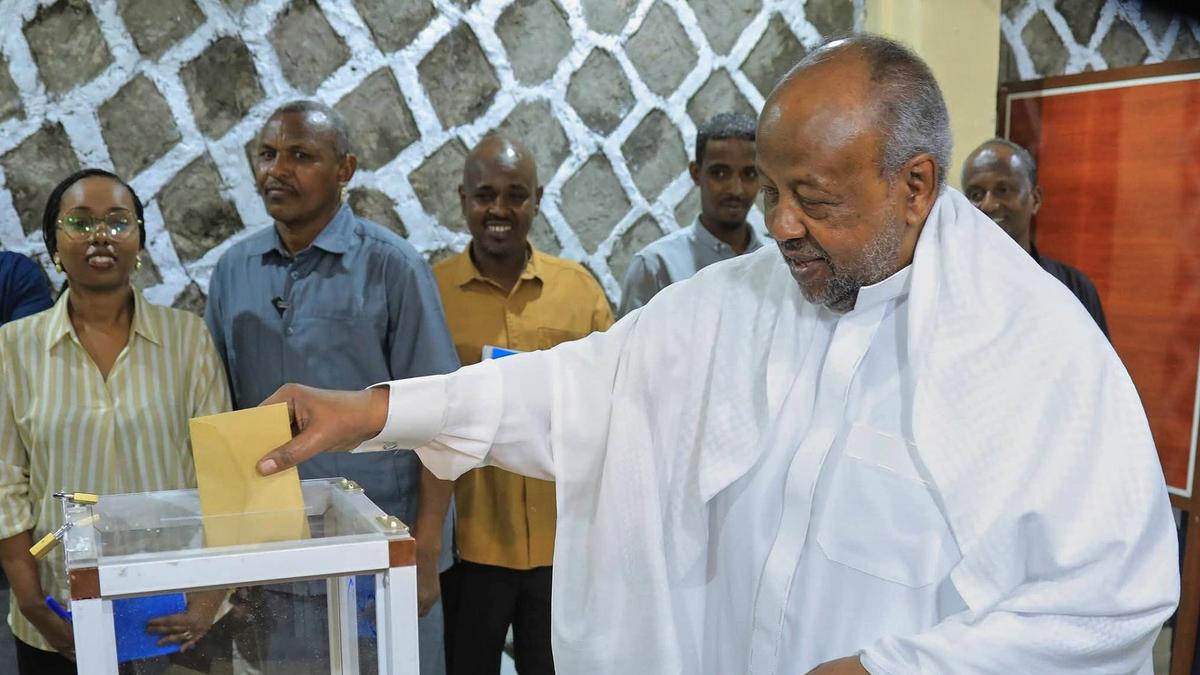
Ismail Omar Guelleh has secured his sixth term as President of Djibouti with a mathematical certainty that renders the word "election" almost purely decorative. Official tallies released this morning confirm Guelleh received 97.81% of the vote, a figure so overwhelming it suggests a national consensus that does not exist in the quiet, tense streets of the capital. His sole challenger, Mohamed Farah Samatar, was left with a negligible 2.19%, a statistical rounding error in a race where the finish line was moved years ago.
This result was never in doubt. For the 1.2 million people living in this arid, strategically vital patch of the Horn of Africa, the 2026 election was less a democratic exercise and more a bureaucratic confirmation of a lifetime appointment. Guelleh, 78, has ruled since 1999, and by the time this new mandate concludes, he will have steered the ship of state for over three decades.
The Constitutional Eraser
To understand how Guelleh achieved this "landslide," one must look back to October 2025. At that time, the President was technically ineligible for another run due to a 75-year age limit he himself had helped codify. In a move that surprised no seasoned observer of Djiboutian politics, the National Assembly—unanimously and without public debate—struck that limit from the constitution.
This wasn't just about age. The legal revisions also introduced a "continuous residence" requirement for candidates, effectively disqualifying the most potent opposition figures currently living in exile. By the time the polls opened on April 10, the political field had been meticulously raked clear of any significant obstacles. The major opposition coalitions, including the Bloc for National Salvation, chose to boycott the proceedings entirely, arguing that participating in a fixed race only serves to legitimize the result.
Geography as Oil
Djibouti possesses no vast oil reserves and little arable land. Its primary export is its coordinates. Situated at the Bab-el-Mandeb Strait—the "Gate of Tears"—Djibouti sits on a maritime chokepoint that sees roughly 12% of all global trade pass through its waters. This geography is the regime's ultimate insurance policy.
The country is currently the world’s most crowded military parking lot. It hosts the only permanent U.S. base in Africa (Camp Lemonnier), alongside major facilities for China, France, Japan, and Italy. These powers pay hundreds of millions in annual rent, providing the Guelleh administration with a steady stream of "base-for-cash" revenue that bypasses the need for a traditional tax-paying middle class.
For Washington, Paris, and Beijing, Djibouti represents a rare island of predictable, if authoritarian, stability in a region defined by the collapse of the Sudanese state and the ongoing volatility in Ethiopia. As long as the ports remain open and the runways are clear, the international community has shown little appetite for critiquing the erosion of Djiboutian democracy.
The Wealth Gap in the Shadow of the Cranes
While the elite in Djibouti City celebrate a sixth term, the economic reality for the average citizen remains grim. The IMF points to steady GDP growth driven by port activity and Chinese-funded infrastructure projects, such as the railway to Addis Ababa. However, this growth rarely trickles down to the dusty outskirts of Balbala.
Youth unemployment remains chronic, and the cost of living has surged as regional instability disrupts food imports. The government’s reliance on debt to fund massive infrastructure projects—largely owed to Beijing—has created a sovereign debt burden that threatens to swallow the country’s future revenues.
The strategy of "stability at any cost" has also stifled the internal intellectual and political life of the nation. When a veteran presidential advisor like Alexis Mohamed resigns in protest against constitutional tampering, as he did in late 2025, it signals a thinning of the inner circle. The regime is increasingly relying on a narrow clan-based power structure, a move that historically precedes institutional fragility in the Horn of Africa.
The Succession Vacuum
By extending his rule indefinitely, Guelleh has avoided a messy succession battle for now, but he has also ensured that when the transition eventually comes, it will be sudden and potentially explosive. There is no clear heir, and the systematic weakening of political institutions means there is no "safety glass" to break in case of an emergency.
The international bases provide a temporary shield against regional spillover, but they cannot protect a regime from the internal pressure of a population that sees 97% victory margins as an insult to their intelligence. For the global powers stationed on the coast, the 2026 election results offer a familiar, comfortable status quo. For Djibouti, it is another five years of treading water while the tide goes out.
The ballots have been counted, and the posters of Guelleh will remain on the walls of the capital. The "Gate of Tears" remains open for business, even if the democratic path for its people remains firmly shut.