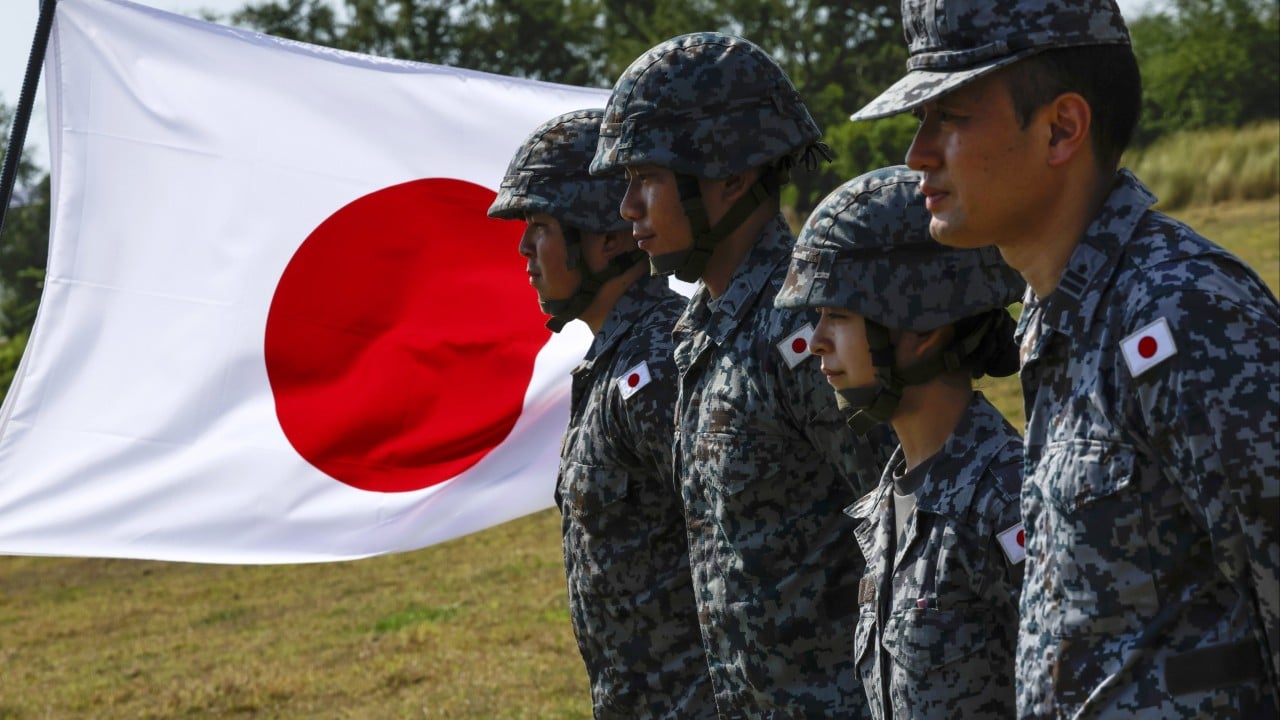
The sea does not care about policy papers. It only knows weight and movement. In the shipyards of Sasebo, the air carries a distinct scent—a mixture of salt spray and the ozone of fresh welding—that tells a story far more visceral than any diplomatic cable. If you stand near the docks, you can feel the vibration of heavy industry shifting gears. It is the sound of a nation deciding that the shield it has carried for seventy years is no longer enough. It needs a sword.
For decades, Japan’s security stance was defined by a specific kind of restraint. It was a quiet, deliberate pacifism born from the ashes of the mid-twentieth century. But the silence is breaking. A revised security policy is moving through the halls of Tokyo, and to those watching from across the East China Sea, it looks less like a defensive adjustment and more like an awakening.
Consider a hypothetical officer named Sato. He is third-generation maritime self-defense. His grandfather saw the end of the old world; his father patrolled the Cold War waters. Sato’s job used to be simple: watch, track, and report. Now, the screens in his command center show a different reality. The gray hulls of neighboring fleets are more numerous, their technology more sophisticated, and their intent more opaque. The tension isn't just a headline. It is the physical sensation of a tightening chest when a radar lock pings from over the horizon.
The Weight of the "Counterstrike"
The core of this tectonic shift lies in a single, heavy word: counterstrike. To the casual observer, it sounds like tactical jargon. In reality, it represents a fundamental psychological break from the past. For the first time since the Second World War, Japan is explicitly seeking the capability to strike targets in enemy territory.
This isn't about aggression in the vacuum of a history book. It is a response to a world where missiles can be fueled and launched in minutes, rendering traditional "interception" a desperate gamble. If you see a punch coming and you only have the right to put your hands up, eventually, a blow will land. Japan is tired of just holding up its hands.
Experts in Beijing watch this with a sharp, calculated skepticism. They see the "Integrated Air and Missile Defense" and the purchase of American-made Tomahawks as a dismantling of the post-war order. To them, Japan isn't just buying weapons; it is shedding its skin. They argue that this "active" defense is a misnomer—that once you build the capacity to strike first, the line between prevention and provocation becomes a blurred, dangerous smear.
A Budget Written in Steel
Numbers usually put people to sleep. But when a country decides to double its defense spending to 2% of its GDP, the numbers start to scream. This is an injection of roughly $320 billion over five years. That money flows into places like the Mitsubishi Heavy Industries plants, where the Type 12 surface-to-ship missiles are being elongated and refined to reach further, hit harder, and fly smarter.
Imagine the logistics of such a shift. It isn't just about buying hardware. It’s about retooling an entire society’s expectation of its role in the world.
- Long-range capabilities: Moving from localized defense to a reach that spans hundreds of miles.
- Cyber warfare divisions: Training thousands of specialists to fight in the invisible architecture of the internet.
- Space-based tracking: Using satellites to ensure that no move in the Pacific goes unnoticed.
The cost is astronomical, and the social friction is real. In a nation with a shrinking, aging population, every yen spent on a missile is a yen not spent on a pension or a hospital bed. This is the invisible stake of the security debate. The Japanese citizen is being asked to choose between the safety of their borders and the comfort of their twilight years. It is a brutal, cold calculus.
The Ghost of 1947
The Article 9 of the Japanese Constitution is a ghost that haunts every cabinet meeting. It is the "Peace Clause," the promise that Japan would never again maintain "war potential." For years, legal scholars have performed Olympic-level mental gymnastics to justify the existence of one of the world’s most powerful militaries under a constitution that technically forbids it.
But the current revision pushes the interpretation to its absolute breaking point. Critics argue that "counterstrike" is just a polite way of saying "pre-emptive war." The fear is that the guardrails are being dismantled one bolt at a time. If the interpretation of the law can change so drastically to meet the "severity of the security environment," then what meaning does the law actually hold?
Yet, there is a counter-argument that feels equally true. A law that prevents a nation from protecting its people against modern, hypersonic threats is not a peace treaty—it is a suicide pact. The tension between these two truths is what makes the air in Tokyo feel so heavy.
The View from the Other Side
Across the water, the perspective is stripped of Japanese nuance. From the viewpoint of a strategist in Beijing, Japan’s moves are part of a larger, suffocating "encirclement" orchestrated by Washington. They see the deepening of the "Quad"—the partnership between Japan, the US, Australia, and India—as a revival of a Cold War mentality.
There is a deep, historical memory at play here. When Japan strengthens its military, it triggers a cellular response in its neighbors. The scars of the 20th century have not faded; they have simply been covered by the neon and glass of modern trade. Every time a Japanese destroyer is launched, it isn't just a ship entering the water. It is a memory resurfacing.
The danger lies in the "Security Dilemma." One side builds a wall to feel safe. The other side sees the wall and builds a ladder to stay even. The first side sees the ladder and builds a taller wall. Eventually, someone falls.
The Invisible Front Line
While the politicians argue over wording in grand halls, the reality of this policy is lived out in the small islands of the Nansei chain. These are tiny specks of green and white sand that have suddenly become the most important real estate on the planet.
On islands like Ishigaki or Yonaguni, the arrival of missile batteries and new troop barracks has transformed quiet fishing villages into front-line outposts. The residents there live with a strange, bifurcated reality. They see the tourists coming for the coral reefs, and they see the military trucks rolling past the pineapple farms. They know that if a conflict breaks out, they are the first ones who will feel the heat.
The policy isn't an abstract concept for them. It is the sight of a radar dome silhouetted against a sunset. It is the knowledge that their home is now a target because it is also a shield.
The Logic of the Unthinkable
Why do it? Why take the risk of alienating a massive trading partner like China? Why spend the money when the debt is already high?
The answer lies in a single, terrifying realization: the old world is gone. The era where American hegemony guaranteed a frictionless Pacific has evaporated. Tokyo has looked at the map and realized that it is essentially an unsinkable aircraft carrier parked in a very dangerous neighborhood.
If the United States is distracted or decides that the cost of defending an ally is too high, Japan stands alone. The revised security policy is a frantic effort to ensure that "standing alone" doesn't mean "falling down." It is a bid for agency. It is a nation deciding that it will no longer be a passenger in its own destiny, even if the driver's seat is a cockpit.
The Silence After the Launch
We often talk about war and peace as if they are light switches. You are either in one or the other. But what we are seeing in the Pacific is the "Grey Zone." It is a state of permanent, high-stakes competition where the goal is to win without ever firing a shot.
Japan’s new stance is designed to make the cost of a shot so high that no one ever pulls the trigger. It is the paradox of modern existence: you must prepare for the very thing you are trying to prevent.
Late at night in the shipyards, the welding stops. The sparks die down. The massive hulls sit in the darkness, waiting for the tide. They are magnificent feats of engineering, symbols of a nation’s pride and its deepest fears. They are mirrors. When Japan looks at these ships, it sees its protection. When China looks at them, it sees a threat.
Both are right.
The tragedy of the human condition is that we have yet to build a shield that doesn't look like a weapon to the person standing in front of it. As the sun rises over the Pacific, it illuminates a region that is more armed, more nervous, and more interconnected than at any point in history. The policy has been revised. The ships are ready. The sea, as always, remains indifferent.