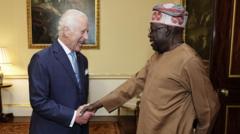
The resumption of formal state visits between Nigeria and the United Kingdom after a 37-year hiatus represents more than a symbolic restoration of bilateral ties; it is a calculated deployment of diplomatic capital to address specific structural deficits in both nations' current economic trajectories. For Nigeria, the visit serves as a high-stakes signaling mechanism to global credit markets regarding the permanence of recent fiscal reforms. For the United Kingdom, it is a strategic pivot toward one of the few remaining high-growth frontiers capable of absorbing British services and high-end manufacturing as traditional European markets stagnate.
The 37-year gap was not merely a chronological coincidence but a reflection of misaligned incentives, ranging from Nigeria’s periods of military rule to the UK’s prior preoccupation with EU integration. The 2026 meeting marks the intersection of two urgent needs: Nigeria’s requirement for Foreign Direct Investment (FDI) to stabilize the Naira and the UK’s "Global Britain" mandate to secure non-European trade corridors.
The Triad of Diplomatic Objectives
Analysis of the official agenda reveals three primary pillars that define the success or failure of this engagement.
1. The Fiscal Credibility Anchor
Nigeria’s current administration has navigated a period of aggressive, often painful, macro-economic recalibration, including the removal of fuel subsidies and the floating of the currency. While these moves were cheered by the IMF, they have yet to trigger the anticipated flood of private equity. The state visit functions as a "seal of approval" from a G7 power, intended to lower the risk premium associated with Nigerian sovereign debt. By securing high-level audience with the City of London’s institutional investors, the Nigerian presidency aims to transition from "emergency stabilization" to "growth-oriented borrowing."
2. Energy Transition and Resource Securitization
The UK’s commitment to Net Zero creates a structural dependency on critical minerals, many of which are under-explored in the Nigerian hinterland. Conversely, Nigeria remains desperate for the modular refinery technology and grid-stabilization expertise held by British engineering firms. The visit is designed to facilitate a "technology-for-access" framework.
3. Migration and Human Capital Export
A critical, though often understated, component of the bilateral relationship is the "Japa" phenomenon—the large-scale migration of Nigerian professionals to the UK. This creates a complex economic feedback loop:
- The Brain Drain Deficit: Nigeria loses its most productive tax-paying demographic.
- The Remittance Surplus: UK-based Nigerians provide a steady flow of hard currency, often exceeding official FDI figures.
- The Service Sector Dependency: The UK’s National Health Service (NHS) and social care systems are increasingly reliant on West African labor to mitigate domestic shortages.
Quantitative Constraints and Market Realities
Beneath the pageantry of a state visit lie hard mathematical constraints that determine the actual utility of such an event. The primary bottleneck is the Currency Mismatch Function. As long as Nigeria’s inflation remains decoupled from its primary trading partners, the cost of servicing UK-sourced infrastructure loans remains prohibitively high in Naira terms.
Furthermore, the UK’s share of Nigerian trade has faced significant erosion from Chinese infrastructure-for-resource swaps and Indian pharmaceutical dominance. To regain market share, British firms must compete on financing terms, not just historical familiarity. This necessitates a revival of the UK Export Finance (UKEF) guarantees, which have historically been underutilized in the West African corridor due to perceived governance risks.
The logic of the 2026 visit suggests a shift toward De-risked Joint Ventures. Rather than simple trade agreements, the focus is shifting toward "Integrated Economic Zones" where British capital enjoys specific legal protections, effectively creating an extraterritorial regulatory environment to bypass local bureaucratic friction.
The Geopolitical Cost of Non-Engagement
The 37-year silence carried a hidden opportunity cost. During this period, the African Continental Free Trade Area (AfCFTA) moved from concept to implementation. Nigeria, as the continent's largest economy, serves as the gatekeeper to this market. By delaying a state-level engagement, the UK allowed competitors to entrench themselves in Nigeria’s digital economy and telecommunications sectors.
The current visit attempts to counteract this via the Digital Economy Partnership. Nigeria’s tech ecosystem, centered in Lagos, requires the depth of London’s capital markets for Series C and D funding rounds. Establishing a direct pipeline between the Nigerian Exchange (NGX) and the London Stock Exchange (LSE) is a priority for the Nigerian delegation, seeking to provide an exit strategy for early-stage investors and thereby encouraging new inflows.
Security as a Prerequisite for Trade
Trade cannot scale in a theater of instability. The northern regions of Nigeria continue to face insurgent threats that disrupt agricultural supply chains and energy pipelines. The UK’s role in this visit includes a "Defense and Security Pact" renewal. Unlike previous iterations that focused on hardware sales, the 2026 framework emphasizes intelligence-led policing and cyber-security infrastructure.
This is a calculated move: if the UK can help secure Nigeria’s transit corridors, it simultaneously protects the investments of British multinationals like Shell and Unilever, which have faced operational disruptions for decades. The cause-and-effect is linear: increased security leads to lower insurance premiums for shipping, which leads to lower landed costs for British goods, which ultimately increases trade volume.
Strategic Execution and Tactical Constraints
The success of this visit will be measured not in the number of handshakes, but in the specific movement of the following metrics over the next 24 months:
- Bond Yield Compression: A reduction in the spread between Nigerian Eurobonds and their emerging market peers.
- Visa Reciprocity Clarity: A formalized path for Nigerian skilled workers that balances the UK’s domestic political pressure to limit migration with its economic need for talent.
- Direct Investment in Value-Add Processing: A move away from raw material export toward "First-Stage Processing" within Nigeria, funded by British capital to satisfy UK supply chain ESG requirements.
The inherent limitation of this diplomatic offensive is the Internal Implementation Gap. No amount of British goodwill can compensate for the potential of domestic policy reversals in Abuja. Investors remain wary of "Regulatory Whiplash," where rules change mid-contract. The visit’s primary mission is to convince the City of London that the current reform trajectory is irreversible.
To capitalize on this diplomatic opening, the Nigerian government must immediately establish a "UK-Nigeria Fast-Track Office" within the Presidency. This body should be empowered to bypass standard ministerial bureaucracy for projects exceeding a $500 million threshold that originate from this visit. Simultaneously, the UK Department for Business and Trade should pivot from "promotion" to "underwriting," using sovereign guarantees to offset the political risk that currently deters mid-cap British firms from entering the Nigerian market. The window for diplomatic arbitrage is narrow; as other global powers recalibrate their African strategies, the historical advantage of the UK-Nigeria relationship will continue to diminish unless it is backed by hard-coded financial incentives and structural legal protections.
Would you like me to analyze the specific sectors of the Nigerian economy most likely to receive British capital under the new UK Export Finance (UKEF) guidelines?