The air inside the mountain smells of wet shale and vinegar. If you stand perfectly still in the dark, you can hear the water dripping—a rhythmic, relentless ticking clock that has been counting down for two millennia.
Most people look at a mountain and see a permanent monument of nature. But in the northwest corner of Spain, in the remote reaches of León, the mountains are not monuments. They are scars.
Two thousand years ago, Roman engineers looked at these same peaks and did not see beauty. They saw an equation. They saw a vault. Inside that vault lay the gold that sustained an empire, funding everything from legions on the Rhine to the games at the Colosseum. To get it, they didn't just dig. They used the mountain's own weight to destroy it.
Walking through the remains of these ancient mining complexes today brings a strange sense of vertigo. It is a technological marvel born of absolute brutality. We often talk about the ancient world in terms of marble statues and philosophical treatises, forgetting that the Roman Empire was, at its core, a massive machine driven by resource extraction. The scale of what happened here defies easy comprehension.
The Weight of an Empire
To understand the sheer madness of Roman mining, we have to look past the gold itself and look at the dirt.
Imagine trying to wash away an entire hillside using nothing but gravity and water. The technique is called ruina montium—literally, the wrecking of mountains. It remains one of the most aggressive engineering feats of human history. Roman writers like Pliny the Elder watched it happen, noting with a mix of horror and pride that the result was "greater than the work of the Giants."
The process was terrifyingly simple in theory, yet agonizingly complex in execution.
First, legions of enslaved laborers tunneled deep into the mountain, carving out narrow, labyrinthine galleries. They didn't use modern explosives, of course. Instead, they relied on fire-setting. They built roaring fires against the rock faces until the stone glowed red-hot, then doused it with cold water and vinegar. The sudden, violent temperature shock shattered the quartz. The workers chipped away the debris, centimeter by centimeter, moving deeper into the dark.
They built these tunnels without a safety margin. They left deliberately weak pillars to support the massive weight of the mountain above. It was a subterranean game of Jenga, played with millions of tons of stone.
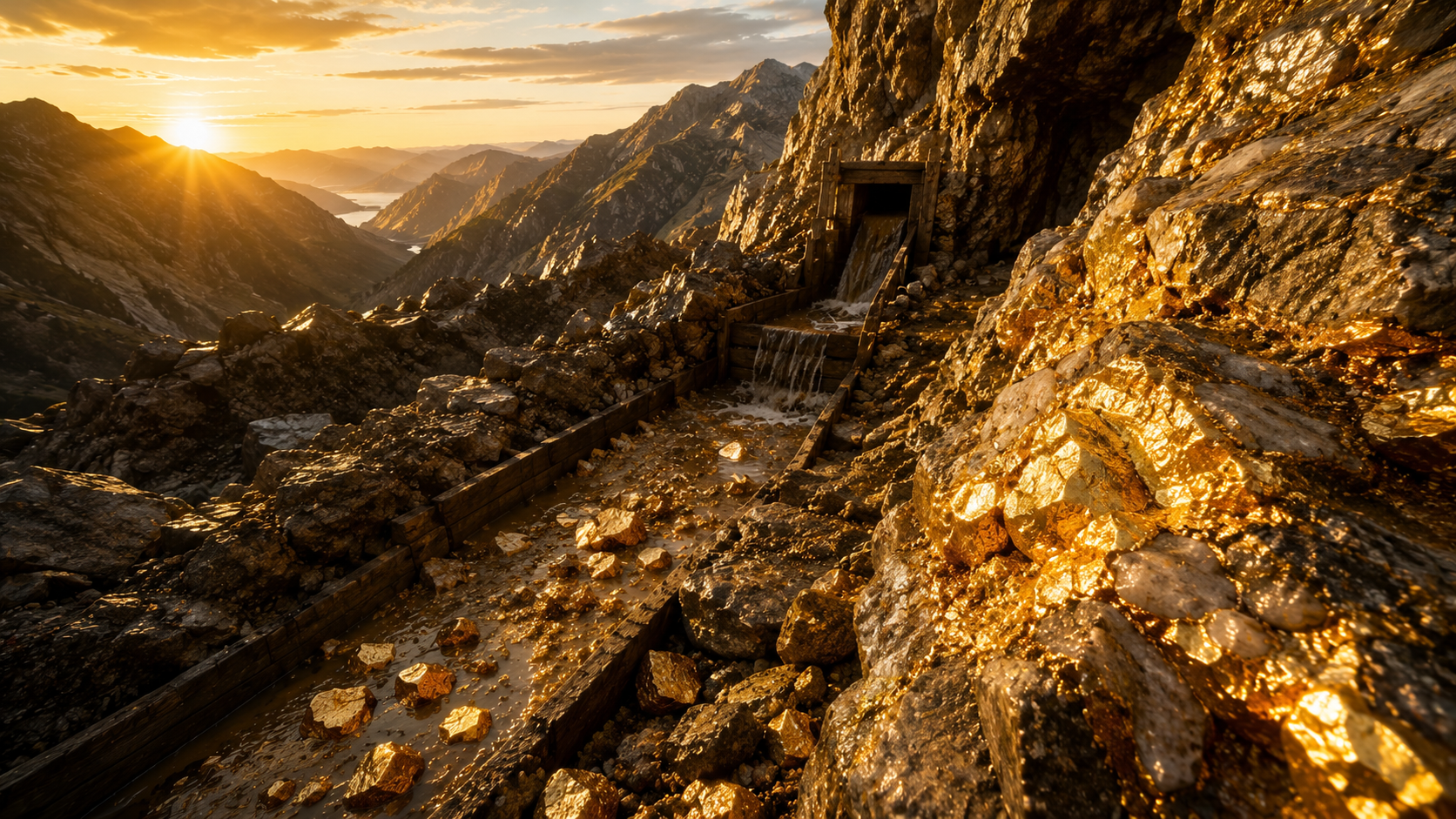
While the tunnels were being dug, other teams worked high above in the blinding sun. They built vast networks of canals, some stretching over a hundred kilometers across the rugged terrain, to capture the runoff from mountain streams. They channeled this water into massive reservoirs constructed at the very crest of the mountain.
When the reservoirs were full and the tunnels below were hollowed out, the engineers pulled the plug.
Thousands of tons of water rushed down enclosed aqueducts, plunging straight into the fragile network of caves. The air inside the tunnels compressed instantly. The trapped air, desperate for escape, fought against the rushing water, creating a pneumatic hammer of unimaginable power. The weakened rock pillars cracked. The mountain literally blew itself apart from the inside out.
Pliny described the sound as a crack of thunder that made the earth tremble for miles. The entire hillside collapsed in a roaring avalanche of mud, boulders, and gold-bearing quartz, pouring down into the valleys below where workers waited to sift through the wreckage.
The Ghost in the Geography
The physical impact of this process is still visible from space. Las Médulas, the most famous of these sites, looks like an alien landscape of jagged clay spires and hollowed-out red cliffs. But recent archaeological work, utilizing aerial laser scanning, has revealed that this wasn't an isolated operation. The empire's thirst for gold was systemic, covering vast swaths of the Iberian peninsula with hidden infrastructure.
The sheer logistics required to pull this off are staggering.
Consider the arithmetic of survival. To feed the thousands of workers, soldiers, and engineers stationed at a single mining site, the Romans had to establish massive supply chains. They shifted entire populations, moving local tribes out of their hillforts and into valley settlements where they could be easily monitored and integrated into the labor force.
It was an early form of industrial mobilization, executed without computers, combustion engines, or electricity. The Romans possessed an uncanny understanding of fluid dynamics. They calculated the precise slope needed for canals to keep water moving at the optimal velocity—not so fast that it eroded the channels, but not so slow that sediment settled and blocked the flow. They measured these gradients across kilometers of uneven mountainous terrain using nothing more than a groma, a simple cross-shaped surveying tool with plumb lines.
When you look closely at the surviving channels cut into the solid slate bedrock, you realize that the real achievement wasn't the gold. It was the control of water. The Romans bent the hydrology of an entire region to their will, turning rivers into precision demolition tools.
The Human Ledger
It is easy to get lost in the numbers. Millions of tons of earth moved. Tons of gold extracted over two centuries. Centuries of imperial dominance.
But numbers are cold. They smooth over the rough edges of human experience.
The real story of the Roman gold mines is found in the silence of the tunnels that didn't collapse. In the claustrophobic side-galleries where a single miner stood in pitch darkness, the only light coming from a small clay lamp burning foul-smelling tallow. The air would have been thick with dust, smoke, and the heavy scent of sweat.
We can estimate that thousands of men died in these mountains. Some were crushed instantly when a tunnel collapsed ahead of schedule. Others succumbed slowly, their lungs destroyed by quartz dust and the toxic fumes of fire-setting. They were the invisible fuel of the Roman economy.
There is a profound disconnect between the grandeur of Rome and the squalor of its resource colonies. The gold washed out of the Spanish mud was minted into aurei, coins stamped with the serene face of an emperor. Those coins paid for the marble monuments in the Forum, the grain doles that kept the urban masses quiet, and the salaries of the soldiers guarding the frontiers. The opulence of the center depended entirely on the devastation of the periphery.
This dynamic isn't unique to antiquity. The global economy still relies on invisible landscapes of extraction. We carry smartphones containing cobalt mined by hand in the Congo; we drive electric cars powered by lithium pumped from Chilean salt flats. The geography changes, the technology evolves, but the fundamental equation remains remarkably consistent. We just don't have to look at the holes we dig.
The Unintended Monument
Eventually, the gold ran out. Or, more accurately, the cost of getting it exceeded its value. As the Roman Empire faced internal political instability and economic crises in the third century, the complex administration required to maintain the Spanish mines began to fracture. The canals fell into disrepair. The reservoirs cracked. The forest slowly reclaimed the scarred hillsides.
Today, chestnut trees grow out of the valleys where millions of tons of mud once flowed. Their roots wrap around the ancient tailings, holding the artificial landscape together. The area is now a UNESCO World Heritage site, praised for its unique cultural value and haunting beauty. Tourists walk the paths where enslaved miners once broken their backs, taking photos of the dramatic red peaks.
It is a strange twist of history that an environmental disaster of this scale has become a scenic wonderland. The jagged cliffs of Las Médulas are not natural formations; they are the garbage piles of an ancient corporate empire.
Standing at the edge of one of the ancient cut-outs as the sun goes down, the red clay seems to glow with an unnatural intensity. The shadows stretch long across the valley floor, filling the deep gashes left by the water. The mountain was broken to build Rome. Now Rome is gone, but the broken mountain remains, a permanent monument to what happens when human ambition meets the bedrock of the earth.