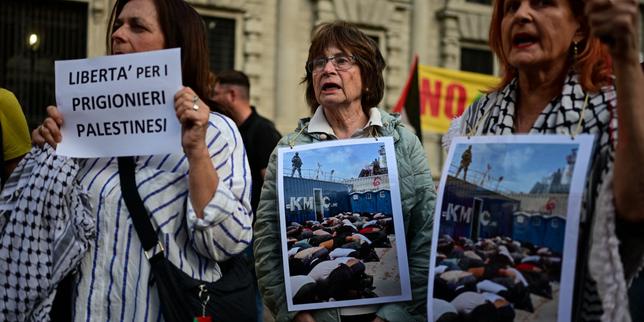
The standard commentary on Euro-Israeli relations is stuck in a loop. Open any mainstream editorial and you will see the same hand-wringing. Critics lament Brussels' supposed "passivity" or "paralysis" in the face of Israel’s shifting political landscape. They paint a picture of a helpless European Union, trapped by internal divisions, unable to project power or enforce its values in the Levant.
This analysis is lazy. It mistakes strategic calculation for weakness.
The premise that Europe is a passive bystander in Middle Eastern politics ignores how power actually operates in Brussels. Europe is not failing to react to Israel’s domestic realignment. It is actively leveraging the current friction to achieve long-standing geopolitical objectives while insulating itself from the fallout. What commentators call "passivity" is actually a highly functional, deliberate policy of managed stasis.
The Illusion of the Unified Actor
To understand why the "passivity" narrative is flawed, you have to look at the structural mechanics of EU foreign policy. Critics often ask: Why doesn't the EU leverage its massive trade agreement to force political concessions?
The question itself betrays a fundamental misunderstanding of the Association Agreement.
Suspension of the EU-Israel Association Agreement requires unanimity among all member states. In a bloc that includes both Dublin and Budapest, achieving unanimity on Levantine politics is structurally impossible. This is not a bug; it is a feature designed to prevent impulsive foreign policy shifts.
I have watched diplomatic delegations spend months debating the placement of a comma in a joint statement. The assumption that the EU can simply turn off a multi-billion-dollar trade relationship overnight is a fantasy entertained only by academic theorists.
Furthermore, economic leverage is a two-way street. The EU is Israel’s largest trading partner, but Israel provides Europe with critical integration in high-tech supply chains, defense technology, and natural gas exploration in the Eastern Mediterranean.
EU-Israel Interdependence Matrix:
[EU Market Access] <---> [Israeli Tech & Security Inputs]
         |                          |
     Economic                   Strategic
    Dependency                 Dependency
Cutting ties to make a moral point would mean cutting off European access to vital security infrastructure at a time when the continent is facing its own existential security threats to the East.
The Quiet Benefits of Friction
The lazy consensus holds that a radicalized or volatile Israeli government is a nightmare scenario for European diplomats. The reality is far more pragmatic.
A highly polarized Israeli administration actually simplifies Europe’s diplomatic chessboard. For decades, European leaders had to navigate the complex illusion of a viable two-state framework, maintaining expensive aid programs and bureaucratic missions that yielded zero structural change. The current political climate strips away the diplomatic theater. It allows Europe to do three things simultaneously:
- Pander to Domestic Audiences: European leaders can issue strongly worded condemnations that satisfy progressive domestic voting blocs without having to enact costly economic sanctions.
- Solidify Regional Alliances: By maintaining a formal distance from Jerusalem's current leadership, Brussels can quietly strengthen its energy and security partnerships with Gulf states and Jordan, presenting itself as the stable, adult partner in the region.
- Maintain Intelligence Cooperations: Beneath the public rhetoric of condemnation, the deep-state apparatus—the exchange of counter-terrorism data, cyber-intelligence, and military tech—remains completely untouched.
This is not passivity. It is optimization. Brussels maximizes its moral capital publicly while preserving its material interests privately.
Dismantling the "People Also Ask" Fallacies
When people look into Euro-Mediterranean relations, they consistently ask the wrong questions because they are operating on outdated assumptions. Let's dismantle the two most common inquiries.
Why doesn't Europe use sanctions like it did against Russia?
This comparison is a false equivalence. Sanctions are deployed against hostile powers that pose a direct, territorial threat to the European mainland or its immediate neighbors. Israel is an integrated node in the Western security architecture.
When you look at the flow of algorithmic warfare tech, drone defense systems, and missile interception research, Europe is a net consumer of Israeli innovation. Imposing sweeping sanctions on a key technological ally while simultaneously trying to rebuild European defense capabilities is a contradiction that no serious strategist would entertain.
Is European division undermining its global credibility?
Only if you define credibility as the ability to dictate terms to sovereign nations outside your borders—a capability Europe has not possessed for over half a century.
If you define credibility as the capacity to protect your own economic zone, secure supply chains, and prevent regional conflicts from spilling over into domestic instability, then the current approach is working. The internal divisions within the EU act as a natural shock absorber. Because the bloc cannot agree on a drastic, disruptive course of action, it defaults to a predictable baseline of economic continuity. Predictability, even when boring, is a form of power.
The Cost of the Contrarian Stance
This pragmatic approach is not without its vulnerabilities. The danger of managed stasis is that it relies on the status quo remaining predictable.
By allowing the political situation to drift, Europe risks being caught off guard by sudden, systemic shocks—such as a complete collapse of regional security frameworks or a massive escalation that forces a hard choice between economic interests and public alliance commitments.
If the Middle East undergoes a fundamental structural shift, Europe’s carefully managed neutrality will look less like a calculated strategy and more like genuine paralysis. But until that tipping point arrives, the current policy serves European interests far better than any grand, moralistic intervention ever could.
Stop looking for grand diplomatic breakthroughs or dramatic ruptures. They are not coming. Brussels will continue to issue its toothless press releases, member states will continue to vote against each other at the UN, and the cargo ships will continue to move across the Mediterranean undisturbed. The system is operating exactly as designed.


