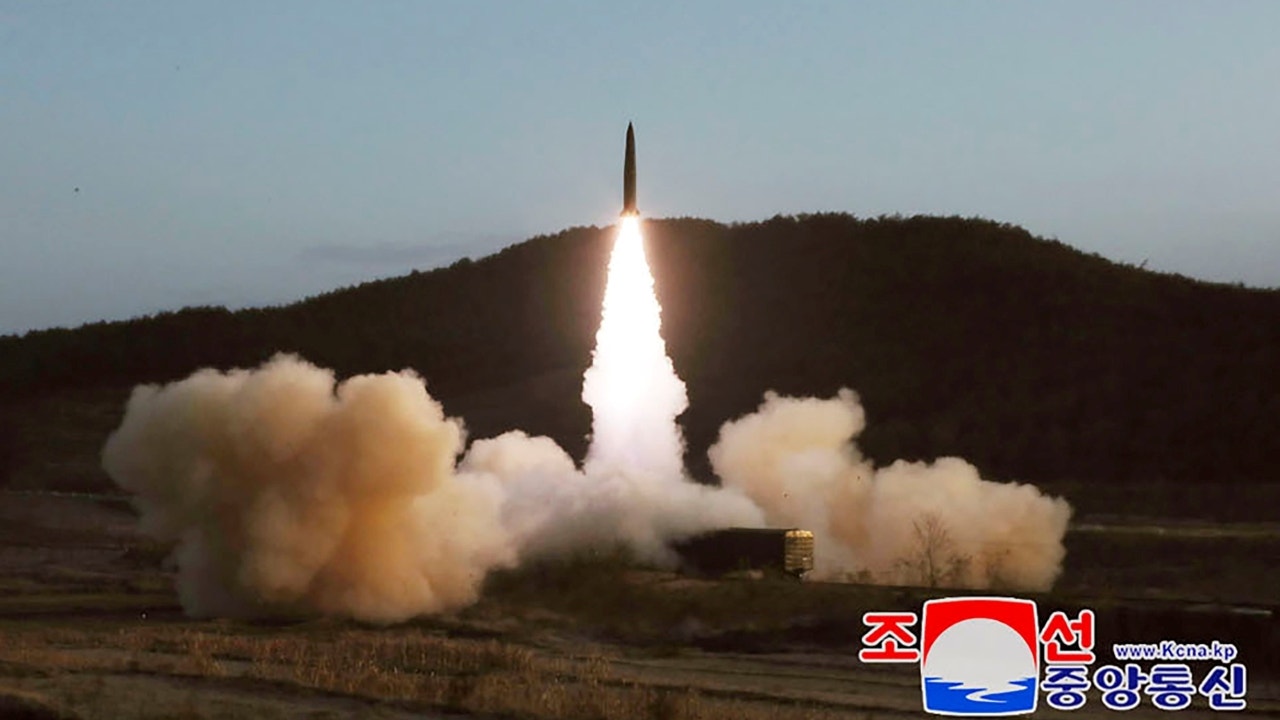
The Western media has a predictable, almost comforting rhythm every time Pyongyang launches a projectile into the Sea of Japan. The headlines scream about "provocations," "escalating tensions," and "defiance of international law." They paint a picture of a rogue state lashing out in a desperate bid for attention.
They are wrong.
What we are witnessing isn't a tantrum. It’s a sophisticated, high-ROI product launch. If you view Kim Jong Un as a "madman" with a button, you’ve already lost the intellectual argument. You have to view him as a CEO with a limited budget, a hostile board of directors (the global community), and a desperate need for market share.
The "lazy consensus" dictates that these tests are a sign of instability. In reality, they are the most stable, calculated moves on the global chessboard. North Korea isn't trying to start a war it knows it would lose in forty-eight hours; it is building a brand of "unacceptable cost."
The Myth of the Failed Launch
Every time a North Korean missile tumbles into the ocean or explodes mid-flight, pundits smirk. They call it a failure. They analyze the telemetry and conclude that the North "isn't there yet."
This is a fundamental misunderstanding of R&D. In the aerospace world, a crash isn't a failure; it’s data. SpaceX followed this exact playbook for years—blowing up rockets on landing pads until they didn't. The difference is we cheer for Elon Musk’s "rapid unscheduled disassemblies" while we mock Kim’s.
By testing in the open, North Korea bypasses the need for the multi-billion dollar simulation labs that the Pentagon relies on. They use the Pacific Ocean as their laboratory. Every "failure" teaches their engineers about structural integrity, stage separation, and re-entry heat shielding. They are iterating in real-time, under the most intense "production" environment imaginable.
Stop Asking if They Can Hit DC
People constantly ask: "Can they actually reach the United States?"
It’s the wrong question. The premise is flawed because it assumes the goal is a successful nuclear strike.
The goal isn't the hit; the goal is the uncertainty.
In game theory, specifically regarding nuclear deterrence, you don't need a 100% success rate. You only need a 5% chance of a warhead surviving re-entry to change the entire diplomatic calculus of a superpower. If Pyongyang can prove they have a non-zero chance of putting a hole in Los Angeles, they have won.
The moment the U.S. intelligence community has to debate whether or not a missile might work, North Korea has achieved strategic parity. They aren't buying weapons; they are buying an insurance policy that pays out in survival.
The Logistics of the Mobile Launcher
The recent tests highlighted "truck-mounted" or "rail-mobile" launchers. This is where the real tech disruption happens.
Most Westerners think of nuclear silos—massive, fixed holes in the ground. Silos are targets. They are easy to track via satellite and easy to neutralize with a preemptive strike. North Korea has moved toward a "shoot and scoot" philosophy.
By utilizing Transporter Erector Launchers (TELs), they turn the entire country into a shell game. You can't "decapitate" a regime if you don't know which tunnel the missile is hiding in. This is lean manufacturing applied to mass destruction. It’s cheaper, harder to track, and infinitely more stressful for South Korean and Japanese missile defense systems like THAAD or Aegis.
Why Sanctions are the Best R&D Department
There is a common belief that sanctions "throttle" North Korea's technical progress. The data suggests the opposite.
Extreme isolation has forced a level of vertical integration that would make Apple jealous. Because they cannot easily import high-end components, they have been forced to master the production of high-grade carbon composites, specialized CNC machinery, and solid-fuel propellants domestically.
Solid fuel is the "killer app" of the latest tests. Liquid-fueled missiles are cumbersome. They take hours to fuel, during which time they are sitting ducks for a drone strike. Solid-fuel missiles, like the Hwasong-18, are essentially "instant-on." You pull them out of a cave, and they are ready to fly in minutes.
The sanctions didn't stop them; the sanctions turned them into the world's most disciplined engineering firm. They have no "lifestyle creep." Every cent of the nation’s diverted GDP goes into the singular goal of ballistic miniaturization.
The Geopolitical Influencer Strategy
Watch the timing of these tests. They never happen in a vacuum. They happen during joint U.S.-South Korea military drills, or right before a major UN summit.
This isn't coincidence; it's "newsjacking."
Kim Jong Un understands the attention economy better than most Silicon Valley CMOs. He knows that a single grainy video of a missile launch on KCTV (Korean Central Television) will dominate the global news cycle for 48 hours. It forces the U.S. Secretary of State to mention North Korea by name. It forces a response.
In the world of international relations, being ignored is death. If you are ignored, you are irrelevant. If you are irrelevant, you are vulnerable to "regime change." By launching missiles, Kim ensures he is always at the top of the "Most Important Issues" list. It is a loud, fiery way of saying, "I am still here, and I am still expensive to fight."
The Cost-Benefit Ratio of the "Rogue State" Label
The term "rogue state" is a gift to Pyongyang. It allows them to operate outside the norms of the "liberal international order" while reaping the benefits of being a nuclear power.
Consider the "Nuclear Club"—the US, Russia, China, France, UK. These nations have to deal with treaties, inspections, and the burden of global leadership. North Korea has none of those overhead costs. They have the ultimate "disrupter" advantage: they don't play by the rules because the rules weren't written for them.
They have successfully transitioned from a failed communist experiment into a nuclear-armed monarchy. That is an objective win in terms of political survival.
The "Brutally Honest" Reality of Denuclearization
Every diplomat talks about "Complete, Verifiable, Irreversible Denuclearization" (CVID).
It is a fantasy. It’s a lie we tell ourselves so we don't have to admit we failed.
No country that has successfully developed nuclear weapons has ever been forced to give them up, with the exception of South Africa (which did so voluntarily during a total regime transition) and Ukraine (which currently deeply regrets it).
Kim Jong Un saw what happened to Muammar Gaddafi in Libya. Gaddafi gave up his nuclear program in exchange for "integration" into the international community. A few years later, he was dragged through the streets. Kim isn't stupid. He knows that his missiles are the only thing standing between him and a similar fate.
When you ask, "How do we get them to stop testing?" you are asking the wrong question. The right question is, "How do we live with a nuclear North Korea?"
The Actionable Truth
If you want to understand what's happening on the Korean Peninsula, stop reading the "outrage" op-eds. Look at the hardware.
The move from liquid to solid fuel, the miniaturization of warheads, and the proliferation of mobile launchers are not "threats." They are facts. They are the result of a thirty-year engineering project that has reached its "Minimum Viable Product" stage and is now scaling.
We are not in a pre-war phase. We are in a post-proliferation phase. The tests are just the marketing department's way of reminding us that the product works.
Stop waiting for the "collapse." Stop waiting for the "denuclearization."
The missiles aren't going anywhere because they are the only thing keeping the lights on in Pyongyang. In a world of predators, the porcupine doesn't need to be faster than the lion; it just needs to be too painful to eat.
Kim Jong Un is the most successful porcupine in history.