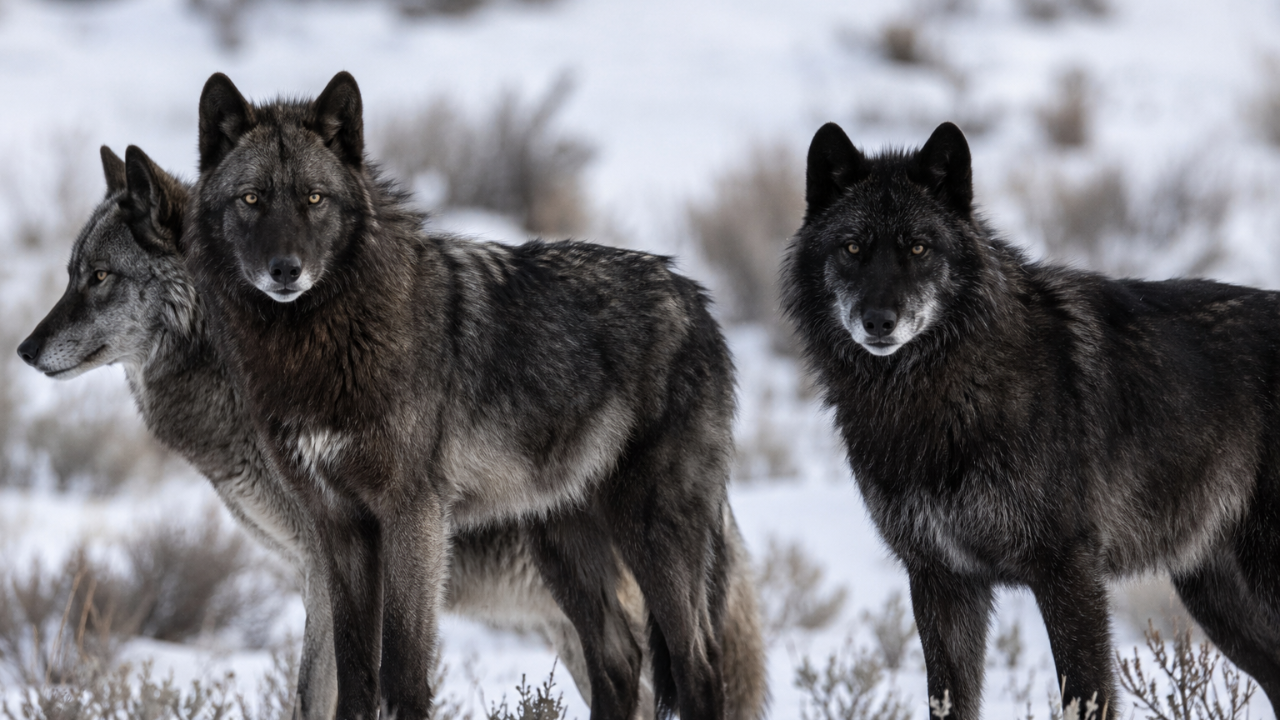
We all know the story. It is the ultimate feel-good nature documentary script. In 1995, wildlife managers released grey wolves back into Yellowstone National Park after a 70-year absence. The wolves ate the overpopulated elk. The terrified elk stopped hanging around riverbanks where they were sitting ducks. Free from constant grazing, willow and aspen trees shot up, beavers returned to build dams, songbirds moved into the new canopies, and the literal shape of the rivers changed.
It is a beautiful narrative of a classic trophic cascade. It is also mostly a fairy tale.
The idea that a handful of predators could single-handedly reverse decades of deep ecological damage makes for great television. It has racked up tens of millions of views in viral internet videos. But nature is rarely that clean, and an increasing stack of hard scientific data shows that we have bought into a massive oversimplification. The real story of Yellowstone is not a simple chain reaction. It is a messy, non-equilibrium puzzle where wolves are just one minor piece of the puzzle.
The Flawed Science of the Fifteen Hundred Percent Boom
The latest blow to the romantic wolf narrative comes from a comprehensive peer-reviewed analysis published in Global Ecology and Conservation. Led by Dr. Daniel MacNulty of Utah State University and Dr. David Cooper of Colorado State University, the researchers took a hard look at the headline-grabbing studies claiming that Yellowstone’s wolves triggered a massive, world-leading ecological rebound.
Specifically, they investigated the widely publicized claim that willow crown volume had surged by an astonishing 1,500% following the return of the wolves.
When you dig into the math, the whole thing falls apart. MacNulty and his team discovered that the original study relied on a circular regression model. The researchers used plant height to both calculate the willow volume and predict it. Mathematically, that guarantees a massive, positive relationship on paper, regardless of what the plants are actually doing in the dirt.
Worse, the original researchers applied this broken model to heavily browsed, misshapen willows that violated the basic assumptions of the math. To top it off, many of the willow plots compared between 2001 and 2020 were not even in the same locations. The apparent explosion of lush green vegetation was largely an artifact of sampling bias and bad math, not a miracle caused by wolf fangs.
Tom Hobbs, a professor at Colorado State University who spent two decades conducting field experiments on Yellowstone’s willows, has been ringing this alarm bell for years. His own field data consistently showed that wolves had very little impact on willow recovery. If you talk to the scientists who actually collect the raw data on the ground, rather than those who model it from a distant office, you get a completely different picture of the park.
Wolves Did Not Scare the Elk Into Saving Trees
The core engine of the popular Yellowstone myth is the "ecology of fear." The theory goes that wolves did not even need to kill all the elk; their mere presence created a landscape of fear that forced elk to avoid narrow valleys and riverbanks.
It sounds logical, but tracking data shows it just does not happen. Decades of GPS collar data analyzed by researchers like Matthew Kauffman at the Wyoming Cooperative Fish and Wildlife Research Unit show that elk do not alter their feeding habits out of sheer terror. An elk is a large, tough animal. While they adapt to predators, they do not abandon prime foraging grounds along rivers just because wolves are in the area.
If the elk population dropped, it was not because wolves were playing psychological chess with them. It was because the elk were getting hit from every conceivable angle.
The Forgotten Predators and the Human Impact
To give wolves all the credit for reducing the elk herd is to ignore the rest of the ecosystem. Wolves are not the only predators in Yellowstone that like the taste of elk.
During the decades of the wolf absence, grizzly bear populations rebounded significantly. Cougars returned to the northern range on their own. Coyotes and black bears take a massive toll on elk calves every spring. When the elk population began to slide from its historic highs in the 1990s, it was the result of a multi-predator tag team, not a solo performance by Canis lupus.
Then there is the biggest predator of all: humans.
When Yellowstone elk migrate out of the protected boundaries of the park during the winter, they cross into Montana. In the late 1990s and early 2000s, Montana wildlife managers issued thousands of hunting licenses specifically targeting antlerless elk to intentionally downsize the herd. Combined with a severe, multi-year drought that dried up forage, the human harvest did far more heavy lifting to reduce elk numbers than wolf predation ever did.
The Unseen Landscape Crisis
Even if you radically cut the elk numbers, you cannot easily fix a broken ecosystem by just dropping a apex predator into the mix. The damage done during the 70 years without wolves ran too deep.
When the wolves were gone, the overpopulated elk ate the willows down to stubs. Because there were no willows, the beavers left. Without beaver dams, streams rushed faster, cutting deep, narrow trenches into the valley floors. The water table dropped.
Willows need a high, steady water table to survive. Once the streams incised and the floodplains dried out, the environment became hostile to willow growth. Dropping 14 wolves into the park in 1995 did not magically raise the water table. It did not bring back the water levels that willows require to thrive.
Today, visitors who look closely at areas like the Lamar Valley will notice it does not look like a pristine paradise. In many spots, it looks like a degraded golf course.
While the elk herd has thinned out, a massive expansion of the resident bison population has filled the void. Thousands of bison now intensively graze the northern range, mowing down native grasses and wild forbs until the ground looks like a sports field. The riverbanks in some valleys remain completely bare of vegetation, causing streams to run shallow, muddy, and hot.
Why We Fight for the Myth
Why does the simplistic trophic cascade story persist so fiercely despite a mountain of conflicting scientific evidence? Because it is comforting.
We love the idea that nature is a perfect machine that can self-correct if humans just step back and replace a missing gear. It makes conservation look easy. It suggests that we can heal complex, deeply altered landscapes with a single, dramatic gesture.
But pretending that ecosystems are that simple is actually dangerous for real-world conservation. It gives the public and policymakers a false sense of security. It implies that rewilding a landscape requires nothing more than dropping a few top predators across a boundary line and letting them do the work.
If you want to support genuine ecosystem recovery, the next step is to stop relying on viral videos and start embracing the messy reality of land management. Real conservation requires long-term water table restoration, complex multi-species grazing management, carefully regulated hunting, and an acknowledgment that some human-induced changes cannot be undone with a quick fix. Wolves belong in Yellowstone because they are a native component of the landscape, not because they are magical ecological engineers.