Walk through the streets of Bordeaux or Nantes at sunset. The light hits the limestone facades of the grand 18th-century mansions, turning them a buttery, opulent gold. To a traveler, it is the height of European elegance. To the historian Ibrahima Thioub, these buildings are not merely architecture. They are ledgers. They are the physical manifestations of a wealth built on the buying and selling of human beings, a reality that France officially recognized as a crime against humanity twenty-five years ago with the passage of the Taubira Law.
Yet, a law is a flat thing. It is ink on parchment. It lacks a pulse.
The Taubira Law was meant to be a beginning, a bridge between a sanitized national myth and the jagged reality of the past. But as Thioub points out, a bridge is useless if people refuse to cross it. A quarter-century later, the French national narrative still treats the history of slavery like a distant, unpleasant weather event—something that happened "over there" in the colonies, rather than something that fundamentally engineered the modern state.
The Ghost in the Ledger
Imagine a merchant in 1750. Let’s call him Pierre. He is not a monster in the eyes of his neighbors. He is a pillar of the community. He attends church, he patrons the arts, and he meticulously records his investments. In his ledger, a human life is a line item, right next to barrels of indigo and sacks of sugar.
When we look at those beautiful port cities today, we see the beauty but ignore the ledger. This is the "insufficient integration" Thioub warns about. We have the law, but we lack the shared imagination to see Pierre’s ledger as part of our own family tree. By keeping the history of slavery in a separate box labeled "Colonial History," the broader national story remains protected, pristine, and false.
The stakes are not academic. They are alive in every classroom and every suburb. When a child of the African diaspora sits in a French school and hears a history of the Republic that begins with the Enlightenment and skips the dark machinery that funded it, they learn a subtle, crushing lesson: You are an asterisk in this story. You are an addition, not an original component.
The Myth of the Clean Break
There is a comfortable lie we tell ourselves about progress. We like to think of history as a series of clean breaks. The 1848 abolition of slavery is often presented as a sudden burst of Gallic virtue, a moment where the Republic simply "decided" to be better.
This narrative erases the decades of bloody revolts in Saint-Domingue. It erases the agency of the enslaved people who made the system untenable through their own resistance. When the Taubira Law arrived in 2001, it was supposed to dismantle this "white savior" version of history. It was supposed to force the state to look at its own hands.
Instead, we have seen a peculiar kind of defensive crouch. Every time the conversation turns toward the systemic legacy of the slave trade, a chorus of voices rises to warn against "repentance" or "self-hatred." They argue that focusing on these crimes will fracture the national identity.
Thioub’s perspective is the opposite. You cannot heal a bone that you refuse to admit is broken. The fracture already exists; the silence is merely the refusal to set the bone.
The Geography of Forgetting
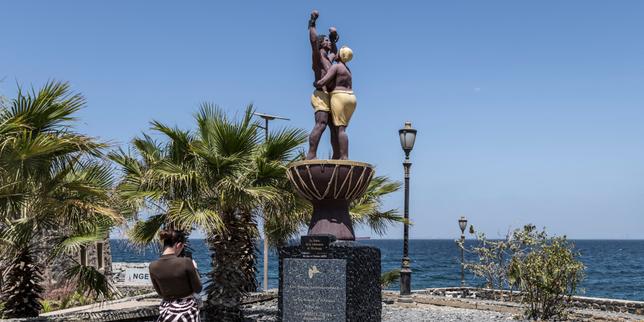
In Gorée Island, off the coast of Senegal, the "Door of No Return" stands as a haunting void. It is a site of pilgrimage, a place where the weight of the past is so heavy it feels like a physical pressure on the chest.
Compare that to the bustling streets of Paris. Where are the markers? Where is the pervasive, everyday acknowledgment that the very marrow of the city’s financial history was enriched by the Code Noir?
We often treat history as a museum—something we visit on a Sunday and leave behind when the doors lock. But history is the ground we walk on. It is the reason certain neighborhoods are wealthy and others are neglected. It is the reason certain accents carry authority and others trigger suspicion.
The Taubira Law mandated that the history of the slave trade be given its "consequent place" in school curricula. But "consequent" is a subjective word. You can teach a fact without teaching its meaning. You can tell a student that 12 million people were trafficked across the Atlantic without ever making them feel the tectonic shift that this theft of life caused in the global economy.
The Invisible Stakes of Memory
Why does this matter now, twenty-five years later? Because we are living in an era of fierce identity politics, where the lack of a shared, honest history is being weaponized.
When a nation refuses to integrate its "difficult" past, it creates a vacuum. In that vacuum, resentment grows. On one side, there is the resentment of those who feel their ancestors' suffering is being minimized. On the other, there is the resentment of those who feel they are being blamed for sins they didn't personally commit.
A human-centric history doesn't seek to assign individual guilt to people living today. It seeks to establish a shared reality. It’s about looking at the limestone facades of Bordeaux and being able to say, simultaneously: "This is beautiful," and "This was paid for in blood."
Holding those two truths at once is the mark of a mature society.
Beyond the Anniversary
The danger of anniversaries is that they offer a false sense of completion. We mark the twenty-five years, we hold a ceremony, we give a speech, and we go back to the status quo.
Ibrahima Thioub isn't asking for more ceremonies. He is asking for a fundamental shift in the "national récit"—the story France tells itself about what it is. This means moving beyond the image of slavery as a peripheral tragedy and recognizing it as a central pillar of the modern world’s construction.
It means understanding that the Enlightenment was happening at the same time as the plantation system. The men who wrote about the "Rights of Man" were often the same men who benefited from the denial of those rights to others. This isn't "cancel culture." It is context. It is the full picture.
The Taubira Law was a hand extended toward the truth. But twenty-five years on, the hand is still hanging in the air, waiting for the rest of the country to grasp it.
We continue to live in the shadow of Pierre’s ledger. We walk through the gold-drenched streets, past the statues of men whose fortunes were built on chains, and we tell ourselves that we are finished with the past. But the past is never finished with us. It breathes through the gaps in our textbooks and echoes in the silence of our grandest squares.
The stones of the city remember, even if the people choose to forget.