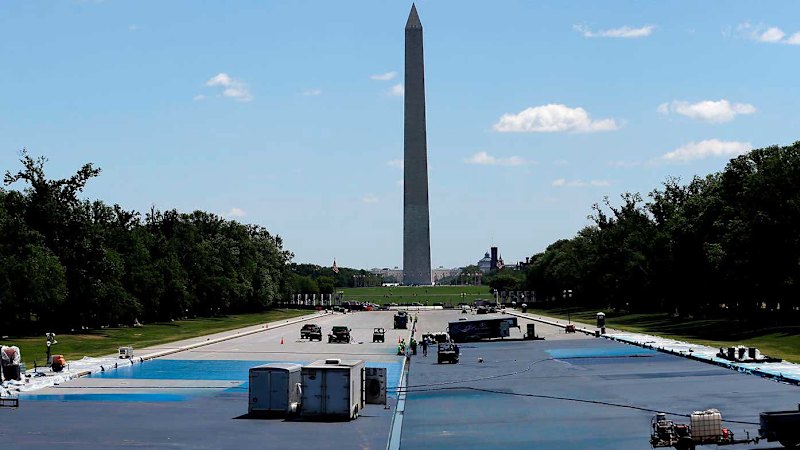
The media is having a collective meltdown because a federal contractor is making money.
A National Park Service analysis just dropped, revealing that Atlantic Industrial Coatings is pulling a 20% overhead and 20% profit margin on its $13.1 million contract to repair and paint the Lincoln Memorial Reflecting Pool. The standard bureaucrat playbook says profit margins for government construction should sit between 6% and 12%. The consensus screaming from the headlines is predictable: taxpayers are getting fleeced, the deal is corrupt, and the sky is falling.
This outrage is financially illiterate.
I have spent decades watching agencies blow millions of dollars on delayed projects because they prioritised low-margin compliance over high-velocity execution. The standard federal procurement process is designed to ensure everyone fills out the paperwork perfectly while the project itself rots in bureaucracy.
The critics are asking the wrong question. They are asking, "Why is this company making so much money?" The real question they should ask is, "What is the premium for speed and accountability on a fixed, high-stakes deadline?"
When you understand the mechanics of emergency contracting, that extra $850,000 in profit isn't a cash grab. It is an insurance premium for the hard deadline of America’s 250th anniversary.
The Flawed Premise of Fixed Federal Margins
Government procurement specialists love the 6% to 12% margin structure because it looks clean on a spreadsheet. It creates an illusion of fiscal responsibility. But this standard framework completely ignores the basic law of risk and reward.
When the government uses a standard, slow-moving bidding process, the contractor takes on minimal risk. The timeline is flexible. If something goes wrong, they file a change order, the timeline stretches by six months, and the taxpayers foot the bill anyway.
The Reflecting Pool project used a rare, accelerated contracting mechanism. Work began before the final price tag was locked in. Why? Because the nation’s 250th anniversary is an absolute, unmovable deadline. The Trump administration used an emergency exemption to avoid serious injury to the government's operational timeline.
When you strip a contractor of the luxury of time, you force them to deploy massive resources immediately. They have to pull crews off other lucrative commercial jobs, pay overtime, and absorb the risk of working on a high-profile, highly scrutinized national monument. Atlantic Industrial Coatings failed to seal the concrete gaps on its first two attempts. Under a standard low-margin contract, a contractor would slow down or walk away to protect their tiny margins. Because they have a 20% cushion, they have the financial incentive to stay on-site, eat the cost of the mistakes, and fix it fast.
High profit margins buy urgency. Low profit margins buy excuses.
Obama Spent $35 Million to Fail for Cheaper
Let us bring some historical data into this conversation. The media loves to point out that the current contract has ballooned from an initial $1.8 million estimate to $13.1 million. They frame this as unprecedented waste.
They completely ignore the Obama administration's attempt to fix the exact same pool.
Between 2010 and 2012, the Obama administration oversaw a massive, fully compliant, heavily structured overhaul of the Reflecting Pool. It cost $35.3 million. It went through every traditional review process, satisfied every committee, and kept profit margins neatly within the bureaucratically approved zones.
The result? The repairs failed to stop the leaks.
The standard process spent nearly three times what the current project costs, took two years, and still left the government with a leaking asset. Yet, the press treats a $13.1 million contract that actually forces a contractor to deliver on an accelerated timeline as a scandal. They prefer a $35 million compliant failure over a $13 million aggressive sprint.
The Trade-Off Nobody Admits
Is this contrarian approach risk-free? Absolutely not.
Giving a no-bid contract to a firm creates a massive leverage asymmetry. By allowing work to start before the price was finalized, the contractor gained incredible leverage. If negotiation broke down, they could walk off, leaving a half-finished asset right before a historic national celebration.
That is the downside. It is messy, it bypasses the Commission of Fine Arts, and it invites intense scrutiny.
But in the real world of project management, you can choose only two: speed, quality, or low cost. The administration chose speed and utility to meet a national milestone.
Imagine a scenario where a fortune 500 company has a catastrophic server failure days before its annual shareholder meeting. Does the CEO wait six months for three competitive bids to save 5% on the contractor's margin? No. They hire the firm that can fix it tonight, and they pay whatever premium that firm demands. The Reflecting Pool is the federal equivalent of that server failure.
Stop evaluating emergency infrastructure projects through the lens of a middle-manager auditing office supplies. The 20% margin isn't a policy failure; it is the market price for a compressed timeline. If the pool is blue, sealed, and filled by the anniversary, the extra $850,000 will be rounding error. Deliver the results, take the profit, and skip the bureaucracy.