Victory Day doesn't feel like a celebration of peace anymore. If you walked through Berlin or Warsaw this week, you didn't see a quiet remembrance of 1945. You saw a powder keg. What used to be a shared moment to honor the defeat of Nazi Germany has morphed into a high-stakes confrontation between Russian tradition and Ukrainian defiance.
It's messy. It's loud. Honestly, it's a bit of a disaster for anyone hoping for a dignified memorial. Across European capitals, the usual flower-laying ceremonies at Soviet war memorials were less about history and more about current headlines. Pro-Ukraine activists and Russian supporters aren't just disagreeing; they're fighting for the soul of the holiday.
The battle for the memorials
Berlin is usually the center of this storm. The city has massive Soviet memorials at Tiergarten and Treptower Park, and every year, they become magnets for tension. This year, German authorities tried to play referee by banning Russian and Soviet flags, military uniforms, and the infamous "Z" symbol.
They wanted to keep the peace. It didn't quite work.
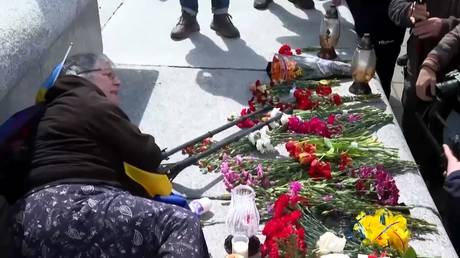
Pro-Ukraine protesters showed up in force. They didn't just stand there with signs; they brought the reality of the current war to the doorsteps of the commemorations. In many cases, they used speakers to drown out Soviet-era songs with Ukrainian anthems or sirens. You'd have a group of elderly people trying to lay carnations while someone a few feet away screamed about war crimes. It's an uncomfortable contrast that makes you realize how thin the veneer of "shared history" has become.
More than just shouting matches
In Warsaw, things got even more pointed. Activists didn't just protest; they built a symbolic cemetery of 100 crosses right outside the Russian embassy. Each cross represented a Ukrainian child killed in the current conflict. This isn't just a "provocation"—it's a deliberate attempt to force people to look at the cost of modern Russian policy while they celebrate a victory from eighty years ago.
Latvia took an even harder line. In Riga and Daugavpils, police weren't playing around. They arrested people just for trying to lay flowers at the sites where Soviet monuments were recently dismantled. To the Latvian government, those flowers aren't a tribute to 1945; they're a middle finger to Latvian sovereignty and a nod to current Russian aggression. By the end of the day, dozens of people were in custody for "glorifying military aggression."
The optics of a scaled back parade
While Europe was clashing in the streets, Moscow was having its own awkward moment. The Red Square parade—usually a massive flex of hardware—was noticeably thin. For the first time in ages, there were no tanks rolling over the cobbles. No ballistic missiles. Just a lone T-34 leading the way and a bunch of troops.
The official reason? Security concerns. The unofficial reason? Most of that gear is currently being used—or destroyed—in Ukraine. Putin tried to spin it as a "just war" against NATO, but the optics told a different story. When you're celebrating a historic victory with a fraction of your usual strength, the message of "everything is fine" starts to fall flat.
Why the tension matters now
You might think these are just fringe activists blowing off steam, but the friction at these events reveals a deeper shift in European identity. Countries in Eastern Europe and the Baltics are done with the Soviet narrative. They don't see the Red Army as "liberators" anymore; they see them as the precursors to the forces currently crossing the Ukrainian border.
- Poland has basically scrubbed Soviet symbolism from its public spaces.
- The Baltics are treating Victory Day as a security threat rather than a holiday.
- Germany is caught in the middle, trying to respect the history of the Holocaust while distancing itself from Moscow's current rhetoric.
This isn't a "provocation" in the sense of a prank. It's a fundamental rejection of how Russia uses history as a weapon. For the pro-Ukraine side, letting these celebrations go unchallenged feels like complicity. For the pro-Russian side, the protests feel like an insult to their ancestors.
What actually happens next
Don't expect next year to be any quieter. As long as the war in Ukraine continues, May 9 will remain a flashpoint. If you're traveling in Europe during this time, you should expect heavy police presence and sudden street closures near any monument.
The "victory" being celebrated is increasingly a matter of perspective. If you want to understand where the continent is headed, stop looking at the official speeches and start looking at what's happening on the sidewalks of Berlin and Riga. The real story isn't the parade; it's the fact that two sides can't even agree on what peace looks like.